

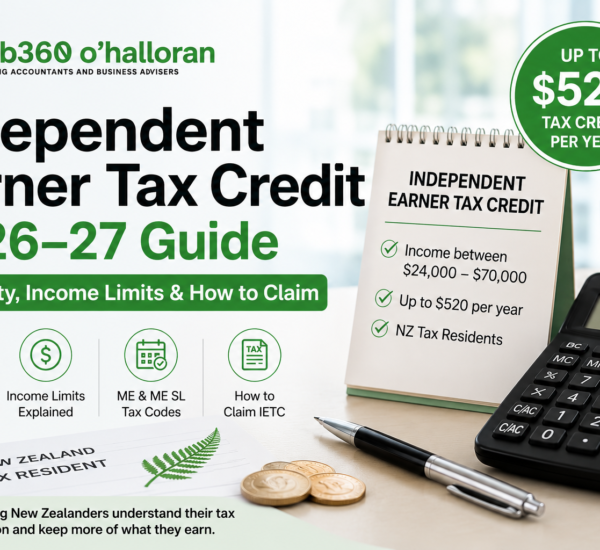
Independent Earner Tax Credit: 2026–27 Eligibility, Income Limits & How to Claim
The Independent Earner Tax Credit (IETC) is a New Zealand tax credit that can reduce the amount of income tax payable by eligible New Zealand tax residents. If you earn between $24,000 and $70,000 a year and meet the other eligibility requirements, you may be entitled to receive up to $520 per year.
The IETC can apply to employees, self-employed people and people receiving certain other types of income. Depending on your circumstances, you may receive the credit through your PAYE deductions during the year or have it calculated when your income tax assessment is completed.
This guide explains the Independent Earner Tax Credit, including who qualifies, the income thresholds, how the $520 credit works, ME and ME SL tax codes, how self-employed people claim it and common mistakes to avoid.
Independent Earner Tax Credit
- The Independent Earner Tax Credit is available to eligible New Zealand tax residents.
- For the 2026–27 tax year, eligible annual net income is between $24,000 and $70,000.
- The maximum IETC is $520 per year, equal to $10 per week.
- The full $520 applies when annual net income is between $24,000 and $66,000.
- For income between $66,001 and $70,000, the credit reduces by 13 cents for every additional dollar earned above $66,000.
- You cannot receive the IETC if you or your partner are entitled to and receive Working for Families.
- People receiving certain benefits, NZ Superannuation or a Veteran’s Pension may not qualify.
- Employees may receive the credit through the ME or ME SL tax code.
- Self-employed people generally claim the credit through their individual income tax return.
- IETC eligibility is calculated by whole months.
What Is the Independent Earner Tax Credit?
The Independent Earner Tax Credit, commonly called the IETC, is a New Zealand tax credit designed for eligible individuals with income within a specified range.
A tax credit reduces the amount of tax you need to pay. The IETC can therefore reduce PAYE deductions during the year or result in a refund or lower tax amount when your annual tax assessment is completed.
According to Inland Revenue, eligible income can include salary and wages, self-employment income, investment income and certain other income sources.
Read the official Inland Revenue IETC guidance
Who Is Eligible for the Independent Earner Tax Credit?
You may qualify for the Independent Earner Tax Credit if you are a New Zealand tax resident and your annual net income is between $24,000 and $70,000, subject to the other eligibility requirements.
You also need to consider whether you or your partner receive Working for Families, an income-tested benefit, NZ Superannuation, a Veteran’s Pension or an overseas equivalent of certain payments.
Eligibility is determined on a monthly basis, so your entitlement can depend on what happened during each month of the tax year.
What Is the IETC Income Limit for 2026–27?
For the 2026–27 tax year, the Independent Earner Tax Credit income thresholds are:
| Annual net income | IETC position |
|---|---|
| Below $24,000 | No IETC entitlement |
| $24,000 to $66,000 | Up to $520 per year |
| $66,001 to $69,999 | Credit reduces by 13 cents for each $1 above $66,000 |
| $70,000 or more | No IETC entitlement |
Inland Revenue’s 2026 payroll specifications confirm the $24,000 lower threshold, $66,000 abatement threshold and $70,000 upper threshold.
View Inland Revenue’s 2026 payroll calculation specifications
How Much Is the Independent Earner Tax Credit?
The maximum Independent Earner Tax Credit is $520 per year, equivalent to $10 per week.
If your annual net income is between $24,000 and $66,000, you can generally receive the full $520, provided you meet the other eligibility conditions.
Once your income exceeds $66,000, the credit starts to reduce.
The credit reduces by 13 cents for every $1 of income above $66,000. Once your income reaches $70,000, the IETC entitlement reduces to zero.
How Does the IETC Abatement Work?
The IETC abatement applies once your annual net income goes above $66,000.
For example, if your annual net income is $67,000, you are $1,000 above the $66,000 abatement threshold.
The reduction would therefore be:
$1,000 × $0.13 = $130
The maximum $520 credit would therefore reduce by $130, leaving a potential IETC entitlement of $390, assuming the other eligibility requirements are satisfied.
This example illustrates how the abatement works. Your actual entitlement can also depend on the months during which you satisfy the eligibility criteria.
What Counts as Income for the Independent Earner Tax Credit?
The IETC uses annual net income rather than simply looking at your salary from one employer.
Depending on your circumstances, income considered for IETC purposes can include:
- Salary and wages
- Self-employment income
- Business income
- Investment income
- Student Allowance
- ACC compensation payments
- Paid parental leave
- Certain business income received through a trust
Allowable deductions and current-year losses can affect the calculation of net income. Losses brought forward from previous years are not included when determining the relevant net income for the IETC.
Who Cannot Receive the Independent Earner Tax Credit?
Meeting the income threshold does not automatically mean you qualify for the IETC.
You generally cannot receive the credit if you or your partner:
- Are entitled to and receive Working for Families tax credits
- Receive an overseas equivalent of Working for Families
- Receive an income-tested benefit
- Receive NZ Superannuation
- Receive a Veteran’s Pension
- Receive an overseas equivalent of certain listed payments
Because eligibility is determined by whole months, receiving a disqualifying payment during a month can affect your entitlement for that month.
Check Inland Revenue’s current IETC eligibility information
Can Employees Get the Independent Earner Tax Credit Through PAYE?
Yes. Eligible employees can receive the Independent Earner Tax Credit through their regular PAYE deductions during the year.
If you qualify and have one main source of salary or wage income, you may be able to use the ME tax code.
If you have a student loan, the relevant main tax code is generally ME SL.
Using the appropriate tax code can reduce the amount of PAYE deducted from your pay during the year.
Inland Revenue: Getting IETC through salary or wages
What Is the ME Tax Code?
ME is a main employment tax code that can be used by eligible employees who qualify for the Independent Earner Tax Credit and do not have a student loan.
The ME tax code allows the IETC to be reflected in PAYE calculations rather than waiting until the end of the tax year.
Employees generally select the appropriate tax code on the Tax code declaration (IR330) and provide the completed form to their employer.
What Is the ME SL Tax Code?
ME SL is used by eligible employees who qualify for the Independent Earner Tax Credit and have a student loan.
The tax code allows the PAYE calculation to account for the IETC while the student loan deductions continue to be calculated under the applicable rules.
Can Self-Employed People Claim the Independent Earner Tax Credit?
Yes. Self-employed people can potentially qualify for the Independent Earner Tax Credit.
Because self-employed income is generally not taxed through PAYE in the same way as salary and wages, the IETC is generally claimed when completing the individual income tax return.
You need to provide the relevant information in your IR3 return and identify the months for which you were eligible.
Inland Revenue: IETC for income from other sources
Can Contractors Get the Independent Earner Tax Credit?
Contractors may be eligible for the IETC depending on their income and overall circumstances.
The way the credit is received can differ depending on how the contractor is paid and whether tax is deducted before the income is received.
If your income is not taxed before you receive it, the credit can generally be calculated through your end-of-year individual tax return.
How Do I Claim the Independent Earner Tax Credit?
The process depends on your source of income.
If You Are an Employee
If you qualify, you may be able to choose the ME or ME SL tax code for your main employment and receive the benefit through reduced PAYE deductions.
If You Are Self-Employed
You generally claim the IETC when filing your individual income tax return.
If You Did Not Receive the Credit During the Year
If you were eligible but did not receive the correct amount during the year, Inland Revenue can calculate the entitlement as part of your income tax assessment. Depending on the tax already paid, you may receive a refund or have an amount to pay.
How Does the Independent Earner Tax Credit Work Month by Month?
IETC entitlement is determined using whole months.
This means that your eligibility can change during the year if your circumstances change.
For example, if you become entitled to Working for Families or begin receiving a qualifying benefit during part of the year, this can affect your IETC entitlement for the relevant month.
Similarly, if you move from a benefit into employment, special rules can apply to determine when your IETC entitlement begins.
Inland Revenue: IETC when moving from a benefit to a job
Independent Earner Tax Credit Example
Suppose an eligible New Zealand tax resident has annual net income of $50,000.
Because the income falls between $24,000 and $66,000, the person may qualify for the maximum $520 IETC, provided the other eligibility requirements are satisfied.
Now consider someone with annual net income of $68,000. Their income is $2,000 above the $66,000 abatement threshold.
The reduction would be:
$2,000 × $0.13 = $260
The potential annual credit would therefore be:
$520 − $260 = $260
These examples are illustrative only. Your actual entitlement can depend on your income, residency and eligibility during each month of the tax year.
What Happens If I Earn More Than $70,000?
If your annual net income reaches or exceeds $70,000, you are not entitled to the Independent Earner Tax Credit for the relevant annual income calculation.
If your income changes during the year, your final entitlement should be calculated based on the applicable rules rather than simply assuming that one pay period determines your annual eligibility.
Independent Earner Tax Credit vs Working for Families
The Independent Earner Tax Credit should not be confused with Working for Families.
They are separate tax-credit systems with different eligibility requirements. If you or your partner are entitled to and receive Working for Families, you cannot also receive the IETC.
This is an important consideration for households where income or family circumstances change during the tax year.
Common Independent Earner Tax Credit Mistakes
Assuming Everyone Earning Between $24,000 and $70,000 Qualifies
The income range is only one part of the eligibility test. Residency, government payments and family circumstances can also affect entitlement.
Using the Wrong PAYE Tax Code
Eligible employees should make sure the tax code they provide to their employer matches their circumstances.
Ignoring Other Sources of Income
IETC eligibility is based on the relevant income calculation, so looking only at your main salary may produce the wrong result.
Forgetting That Eligibility Is Monthly
Your circumstances during individual months can affect the amount of IETC you are entitled to receive.
Assuming the $520 Is Automatically Paid
The maximum credit is $520, but not everyone receives the full amount. Income above $66,000 can reduce the entitlement, and other eligibility conditions also apply.
Independent Earner Tax Credit Checklist
| Question | What to check |
|---|---|
| Are you a NZ tax resident? | Confirm your New Zealand tax residency status. |
| Is your annual net income between $24,000 and $70,000? | Check your total relevant income and allowable deductions. |
| Is your income between $24,000 and $66,000? | You may qualify for the maximum $520, subject to other conditions. |
| Is your income above $66,000? | Your IETC entitlement may be reduced. |
| Do you receive Working for Families? | This can make you ineligible for IETC. |
| Do you receive a qualifying benefit or NZ Super? | This can affect your eligibility. |
| Are you an employee? | Check whether ME or ME SL is appropriate. |
| Are you self-employed? | Check your eligibility when completing your IR3. |
Professional Tax Support From DFK Orb360 O’Halloran
Understanding whether you qualify for the Independent Earner Tax Credit can be difficult when you have multiple income sources, changing employment, self-employment income or changes in your family circumstances.
DFK Orb360 O’Halloran provides accounting and tax advisory services for individuals and businesses across New Zealand.
Our team can help you understand your income tax position, tax credits, compliance requirements and broader tax obligations.
Speak to a DFK Orb360 tax expert
Not Sure If You Qualify for the Independent Earner Tax Credit?
Your income is only one part of the IETC eligibility test. If you are unsure whether you qualify, have multiple income sources or want help reviewing your New Zealand tax position, speak with the DFK Orb360 O’Halloran team.
Request tax advice and discuss your circumstances with our team.
People Also Ask About the Independent Earner Tax Credit
What is the Independent Earner Tax Credit?
The Independent Earner Tax Credit is a New Zealand tax credit for eligible NZ tax residents with annual net income within the applicable income range. The maximum credit is $520 per year.
Who qualifies for the Independent Earner Tax Credit?
Eligible New Zealand tax residents with annual net income between $24,000 and $70,000 may qualify, provided they meet the other requirements relating to Working for Families, benefits, NZ Superannuation and other circumstances.
How much is the Independent Earner Tax Credit?
The maximum Independent Earner Tax Credit is $520 per year, equivalent to $10 per week. The full amount applies between $24,000 and $66,000 of annual net income, subject to eligibility.
What happens to IETC if I earn over $66,000?
The Independent Earner Tax Credit reduces by 13 cents for every dollar of annual net income above $66,000. The entitlement reaches zero at $70,000.
Can I get the Independent Earner Tax Credit if I am self-employed?
Yes. Self-employed people can qualify for the IETC if they meet the relevant requirements. The credit is generally claimed through the individual income tax return rather than through an employee PAYE tax code.
Can I get IETC if I receive Working for Families?
No. If you or your partner are entitled to and receive Working for Families, you cannot receive the Independent Earner Tax Credit.
What tax code gives the Independent Earner Tax Credit?
Eligible employees can generally use the ME tax code if they do not have a student loan, or ME SL if they have a student loan, where the relevant requirements are met.
Is the Independent Earner Tax Credit paid weekly?
Eligible employees can receive the benefit through reduced PAYE deductions during the year. The maximum annual entitlement is $520, which is equivalent to $10 per week.
Can I claim IETC at the end of the tax year?
Yes. If you were eligible but did not receive the credit during the year, Inland Revenue can calculate your entitlement through your income tax assessment.
Does IETC depend on monthly eligibility?
Yes. Independent Earner Tax Credit eligibility is determined using whole months. Changes in income or circumstances during the year can therefore affect your total entitlement.
Official Inland Revenue Resources
- Inland Revenue – Independent Earner Tax Credit
- Inland Revenue – IETC for salary and wages
- Inland Revenue – IETC for other income
Final Thoughts on the Independent Earner Tax Credit
The Independent Earner Tax Credit can reduce the tax payable by eligible New Zealand tax residents earning within the relevant income range.
For the 2026–27 tax year, the maximum credit is $520. The full credit is available between $24,000 and $66,000, while the entitlement gradually reduces between $66,001 and $70,000.
However, income is not the only factor. Your tax residency, family circumstances, government payments and income sources can all affect your eligibility.
If you are unsure whether you qualify or need help reviewing your tax position, professional advice can help you understand the rules that apply to your circumstances.
Disclaimer: This article provides general educational information and does not constitute personalised tax or financial advice. Eligibility and tax outcomes depend on individual circumstances and current New Zealand tax legislation. Check the latest Inland Revenue guidance or speak with a qualified tax adviser for advice specific to your situation.
Reviewed: September 2026



 09 377 4238
 Level 2, 6 Kingdon Street, Newmarket, Auckland
 help@orb360.co.nz