
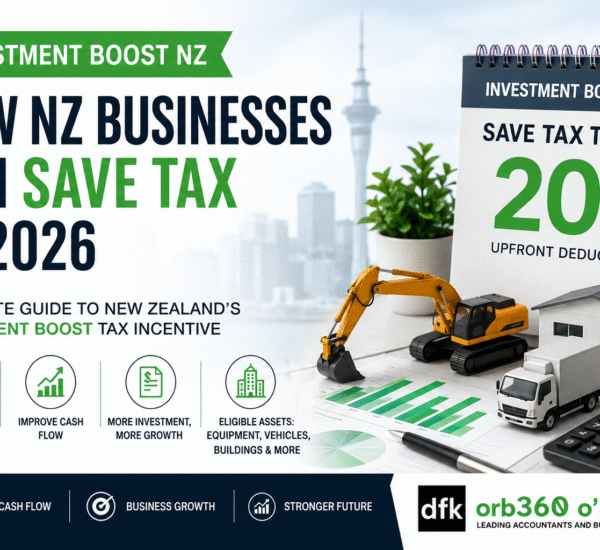
Investment Boost is a New Zealand tax incentive that allows eligible businesses to claim an immediate 20% tax deduction on qualifying depreciable assets acquired on or after 22 May 2025.
Businesses can continue claiming depreciation on the remaining asset value, allowing them to access larger deductions earlier while improving cash flow and supporting business growth.
The initiative is designed to encourage investment, increase productivity, and support economic growth across New Zealand.
In This Guide You’ll Learn:Investment Boost NZ is a tax incentive that allows eligible businesses to claim an upfront deduction equal to 20% of the cost of qualifying depreciable assets acquired on or after 22 May 2025. Businesses can also continue claiming depreciation on the remaining value of those assets under normal Inland Revenue rules.
Investment Boost is a New Zealand business tax incentive introduced to encourage investment in productive assets and improve long-term economic growth.
The scheme allows businesses to claim an immediate 20% deduction on eligible depreciable assets acquired on or after 22 May 2025.
Unlike standard depreciation, which spreads deductions over multiple years, Investment Boost accelerates part of the deduction into the year the asset becomes available for use.
This gives businesses access to earlier tax relief while continuing to benefit from depreciation on the remaining asset value.
Official Inland Revenue guidance can be found here: Investment Boost – Inland Revenue
Businesses that invest in productive assets often become more efficient, competitive, and profitable.
Investment Boost was introduced to encourage organisations to invest in growth-enhancing assets that improve operational performance.
Many businesses delay major purchases because of the upfront financial commitment involved.
By providing earlier tax deductions, Investment Boost reduces the after-tax cost of investment and may encourage businesses to invest sooner.
The policy is intended to support economic growth by encouraging businesses to invest in productive assets, modern technology, and operational improvements.
Increased investment often contributes to higher productivity, stronger business performance, and job creation.
Investment Boost may be available to many New Zealand businesses that acquire qualifying depreciable assets.
Sole traders operating businesses may be eligible where qualifying assets are used for business purposes.
Partnerships may be able to claim Investment Boost on eligible assets used within the business.
Companies are expected to be among the primary users of the Investment Boost incentive due to ongoing capital expenditure requirements.
Businesses operated through trusts may also qualify depending on the nature of the business and asset ownership structure.
Agricultural businesses frequently invest in productive assets and may benefit from Investment Boost.
For detailed eligibility information, see our guide:
Eligible Assets Under Investment Boost NZ
Investment Boost generally applies to qualifying assets acquired on or after 22 May 2025.
However, eligibility may depend on when an asset becomes available for use rather than simply when it was ordered or paid for.
This distinction is important when determining whether a business qualifies for the deduction.
Maintaining complete records can help support Investment Boost claims if Inland Revenue requests additional information.
Investment Boost provides an immediate deduction equal to 20% of the cost of a qualifying asset.
After claiming the Investment Boost deduction, businesses continue depreciating the remaining value of the asset under standard tax depreciation rules.
This means businesses can access larger deductions earlier while continuing to benefit from future depreciation claims.
For practical scenarios and calculations, read:
One of the most common questions businesses ask is whether Investment Boost replaces standard depreciation.
The answer is no.
Investment Boost and depreciation work together.
Under standard Inland Revenue depreciation rules, businesses claim deductions gradually over the useful life of an asset.
This means the tax benefit is spread across multiple years.
Investment Boost accelerates part of the deduction into the first year.
Businesses can claim a 20% upfront deduction and continue depreciating the remaining value of the asset.
This allows businesses to access tax savings sooner while maintaining future depreciation benefits.
For official depreciation guidance, visit:
Yes.
Eligible businesses can generally claim:
This combination can significantly improve cash flow and reduce taxable income during the early years of ownership.
Businesses no longer need to wait several years to recover the full tax benefit of qualifying investments.
Earlier deductions can provide immediate financial advantages.
Reducing taxable income sooner may lower tax liabilities and improve short-term liquidity.
Improved cash flow can help businesses fund additional investments and growth initiatives.
Investment Boost reduces the effective after-tax cost of purchasing productive assets.
This may encourage businesses to move forward with planned investments sooner.
Investment in productive assets often leads to greater efficiency, improved customer outcomes, and stronger long-term profitability.
Unlike some government incentives, Investment Boost is generally claimed through normal tax reporting processes.
Businesses do not typically need to submit a separate application.
Not every business purchase is eligible for Investment Boost.
Before making a claim, businesses should review Inland Revenue requirements carefully.
For more information:
Eligible Assets Under Investment Boost NZ
Eligibility often depends on when an asset becomes available for use.
Businesses should understand the timing rules before lodging a claim.
Missing invoices, contracts, and depreciation schedules may create issues if Inland Revenue reviews a claim.
Comprehensive documentation is essential.
Investment Boost works alongside depreciation.
Businesses should ensure calculations are accurate and supported by proper records.
Investment Boost should be viewed as part of a broader business strategy rather than simply a tax deduction.
When used effectively, it can support long-term growth and capital investment decisions.
Businesses considering significant purchases should evaluate:
Many businesses invest in productive assets to:
Investment Boost may help improve the financial return on these investments.
Tax legislation can be complex, particularly when multiple deductions and depreciation rules interact.
Working with experienced tax advisors can help businesses maximise available benefits while remaining compliant.
While Investment Boost may benefit many sectors, some industries are likely to experience particularly strong advantages due to ongoing capital investment requirements.
Manufacturers regularly invest in equipment, production systems, and operational infrastructure.
Construction businesses often acquire productive business assets to support projects and operational growth.
Agricultural businesses frequently invest in productive assets as part of ongoing operations.
Transport businesses often require significant investment in operational assets and infrastructure.
Professional service firms increasingly invest in technology, cybersecurity, digital transformation, and operational systems.
If you’re researching Investment Boost, these additional resources may help:
Together, these guides provide a complete overview of Investment Boost eligibility, calculations, and tax planning opportunities.
Investment Boost is a New Zealand tax incentive that allows eligible businesses to claim an immediate 20% deduction on qualifying depreciable assets acquired on or after 22 May 2025.
Eligible New Zealand businesses, including sole traders, partnerships, companies, and trust-owned businesses, may qualify depending on the nature of their investments and compliance with Inland Revenue requirements.
Yes. Small businesses can generally claim Investment Boost provided they acquire qualifying assets and meet eligibility requirements.
Yes. Businesses can claim the upfront Investment Boost deduction and continue depreciating the remaining value of the asset under normal depreciation rules.
The deduction is generally equal to 20% of the cost of a qualifying asset, with depreciation continuing on the remaining balance.
For practical examples, read: Investment Boost NZ Examples
Asset eligibility depends on Inland Revenue rules and whether the asset meets qualifying criteria.
For a detailed breakdown, read: Eligible Assets Under Investment Boost NZ
Investment Boost is generally claimed through your income tax return together with supporting depreciation schedules and asset records.
Continue learning about Investment Boost through our related guides:
Investment Boost represents one of the most significant business tax incentives introduced in New Zealand in recent years.
By allowing eligible businesses to access tax deductions sooner, the initiative supports investment, productivity improvements, and long-term economic growth.
Understanding the rules around eligibility, timing, depreciation, and tax reporting is essential to ensuring businesses receive the full benefit of the incentive.
As with any tax-related decision, obtaining professional advice can help businesses maximise available deductions while maintaining compliance with Inland Revenue requirements.
At DFK Orb360, we help New Zealand businesses identify qualifying investments, maximise tax deductions, prepare depreciation schedules, and maintain Inland Revenue compliance.
Whether you’re considering a major investment or reviewing your existing asset purchases, our team can help ensure you’re making the most of available tax incentives.


Copyright © 2025 Marketing Transformers | All Rights Reserved.


 09 377 4238
 Level 2, 6 Kingdon Street, Newmarket, Auckland
 help@orb360.co.nz