
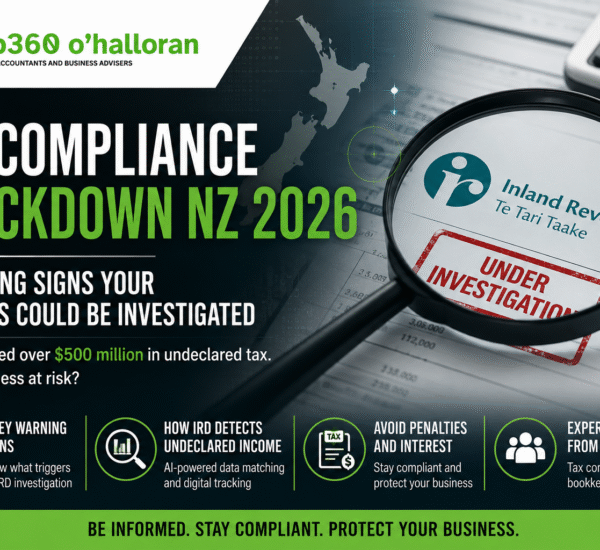
New Zealand’s Inland Revenue Department (IRD) has intensified tax compliance investigations after uncovering more than $500 million in undeclared tax. Businesses, contractors, landlords, and self-employed individuals across NZ are facing increased scrutiny through AI-powered data matching and digital financial tracking.
The ongoing IRD compliance crackdown NZ businesses are facing in 2026 is one of the biggest tax enforcement shifts in recent years.
Experts believe the IRD compliance crackdown NZ authorities are conducting will continue expanding through AI-powered financial monitoring.
Small businesses affected by the IRD compliance crackdown NZ campaign should review GST filings, declared income, and bookkeeping records carefully.
The recent IRD compliance crackdown NZ investigations highlight how aggressively undeclared income is now being monitored.
Understanding the IRD compliance crackdown NZ process can help businesses reduce audit risks and avoid penalties.
Common audit triggers include undeclared income, GST mismatches, cash transactions, and inaccurate expense claims.
DFK Orb360 helps NZ businesses stay compliant with GST, bookkeeping, tax planning, IRD payment arrangements, and audit support services. Businesses concerned about an IRD investigation or undeclared tax issues should seek professional accounting advice early to reduce penalties and compliance risks.
New Zealand’s Inland Revenue Department (IRD) has uncovered more than $500 million in undeclared tax during a major nationwide compliance crackdown — sending a strong message to businesses and individuals across NZ.
From undeclared cash income to GST irregularities and rental property earnings, IRD is now using advanced data-matching technology and AI-driven systems to identify suspicious financial activity faster than ever before.
If you are a business owner, contractor, freelancer, property investor, or self-employed professional, this is not something to ignore.
The recent IRD investigation activity shows a major shift in how tax compliance is being enforced in New Zealand.
IRD is actively targeting:
Many NZ businesses assume audits only happen to large companies. That is no longer true.
Small businesses, sole traders, and self-employed individuals are increasingly being reviewed due to digital payment tracking and automated compliance systems.
IRD now cross-checks financial data from multiple sources including:
Even small inconsistencies can trigger a review.
For example:
These red flags can lead to compliance checks or full audits.
If your business has:
DFK Orb360 can help you review your financial position before issues escalate.
Contact DFK Orb360 today for professional accounting support across New Zealand.
Consistently filing GST or income tax returns late may increase compliance risk.
Cash-heavy industries are under increased monitoring by IRD.
Claiming unusually high business expenses without supporting evidence may trigger reviews.
Freelance work, online sales, crypto profits, and side hustles must still be declared.
IRD is heavily monitoring rental income and property-related tax obligations.
Differences between sales records and GST returns are major audit triggers.
Incorrect PAYE filings or contractor misclassification can raise compliance concerns.
An IRD audit can vary from a simple information request to a detailed financial investigation.
IRD may request:
If undeclared income or reporting errors are found, penalties and interest charges may apply.
In serious cases, legal action is possible.
Freelancers, influencers, consultants, and self-employed professionals are also seeing increased compliance reviews.
Proactive tax management is significantly cheaper than dealing with penalties later.
As IRD increases enforcement activity, having professional accounting support is becoming essential for NZ businesses.
At DFK Orb360, we help businesses across New Zealand with:
If you have received an IRD notice, are behind on taxes, or want to reduce compliance risks, our team can help.
Yes. IRD uses advanced data-matching technology to compare financial information from banks, employers, property records, payment platforms, and overseas tax systems.
Common triggers include late tax filings, GST mismatches, undeclared income, unusually high expense claims, cash transactions, and payroll inconsistencies.
Failure to declare income may result in penalties, interest charges, repayment obligations, and in serious cases, prosecution.
IRD can access financial information through data-sharing systems and investigations when required under New Zealand tax laws.
In many cases, IRD can review several previous tax years, especially where serious non-compliance or fraud is suspected.
Yes. IRD audits businesses of all sizes, including sole traders, freelancers, contractors, and startups.
Maintaining accurate records, filing returns on time, declaring all income, and working with an accountant can significantly reduce compliance risks.
The IRD compliance crackdown is a major warning for businesses and individuals across New Zealand. With AI-driven monitoring and stronger enforcement activity, undeclared income and inaccurate tax reporting are becoming much easier for IRD to detect.
Businesses that act early, maintain proper records, and seek professional guidance are far more likely to avoid costly penalties and compliance stress.
If you need help managing tax compliance, GST obligations, or responding to IRD notices, contact DFK Orb360 today.


Copyright © 2025 Marketing Transformers | All Rights Reserved.


 09 377 4238
 Level 2, 6 Kingdon Street, Newmarket, Auckland
 help@orb360.co.nz