
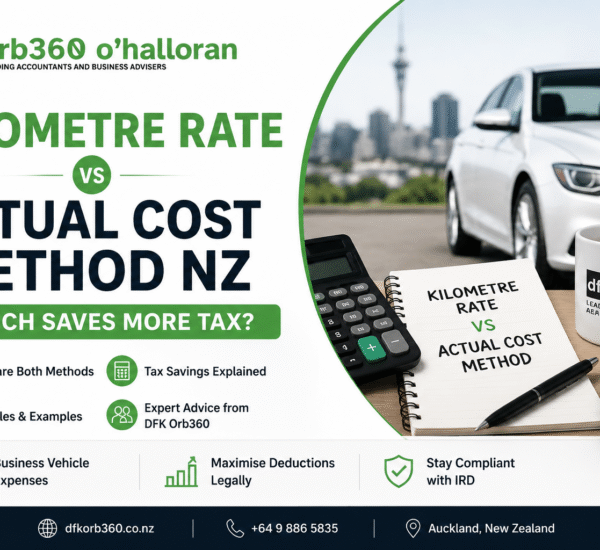
If you use your vehicle for business in New Zealand, one of the biggest tax questions you’ll face is whether to claim vehicle expenses using the Kilometre Rate Method or the Actual Cost Method.
Choosing the right method can significantly affect the amount you claim as a tax deduction. While the kilometre rate method is simpler and faster, the actual cost method may provide a larger deduction depending on your circumstances.
In this guide, the Chartered Accountants at DFK Orb360 explain the differences between both methods, who each method is best suited for, and how to determine which option could help reduce your taxable income while remaining compliant with Inland Revenue (IRD).
The Kilometre Rate Method calculates business vehicle expenses using the official IRD kilometre rates published each year. The Actual Cost Method allows taxpayers to claim the real costs of owning and operating their vehicle, including fuel, insurance, servicing, repairs, registration, depreciation, and other eligible expenses, based on the proportion of business use.
Many business owners automatically use the kilometre rate because it’s simple. However, simplicity doesn’t always result in the biggest tax deduction.
Choosing the wrong claim method could mean:
The most suitable approach depends on factors such as:
The Kilometre Rate Method allows eligible taxpayers to calculate business vehicle expenses using the official rates published annually by Inland Revenue.
Rather than tracking every individual vehicle expense, taxpayers simply multiply eligible business kilometres by the applicable IRD kilometre rate.
The rates are designed to include estimated costs such as:
Instead of relying on IRD kilometre rates, the Actual Cost Method calculates deductions based on the actual expenses incurred during the year.
Eligible costs may include:
Business owners then determine the business-use percentage and claim that proportion of eligible vehicle expenses.
There isn’t a “best” method for every taxpayer. Businesses with relatively low running costs often prefer the kilometre rate method, while businesses operating expensive vehicles or travelling significant distances may achieve a better tax outcome using actual vehicle costs.
The most suitable method depends on your individual circumstances.
Choosing between the Kilometre Rate vs Actual Cost Method NZ depends on your business activities, vehicle running costs, and the level of record keeping you’re willing to maintain.
Choosing the right Kilometre Rate vs Actual Cost Method NZ can affect your tax deductions, record-keeping requirements, and overall business compliance. Reviewing both methods before preparing your tax return can help ensure you’re using the most appropriate approach.
| Feature | Kilometre Rate Method | Actual Cost Method |
|---|---|---|
| Calculation Method | Official IRD kilometre rates | Actual vehicle expenses |
| Record Keeping | Mileage log | Mileage log + receipts |
| Administration | Low | High |
| Suitable For | Most sole traders | Businesses with higher vehicle costs |
| Time Required | Minimal | More detailed |
| Potential Tax Savings | Moderate | Potentially higher |
There is no universal answer.
The Kilometre Rate vs Actual Cost Method NZ comparison depends on several factors, including:
Businesses with relatively low operating costs often find the kilometre rate method sufficient. Businesses with higher annual vehicle expenses may receive a larger deduction using actual costs.
Scenario
In many cases, using the kilometre rate method provides a simple solution with minimal paperwork while producing a reasonable tax deduction.
For businesses with relatively modest vehicle expenses, the administrative simplicity often outweighs the benefit of calculating every actual expense.
Scenario
Because actual vehicle expenses are considerably higher, the Actual Cost Method may result in a larger deductible amount.
Professional advice should be obtained before deciding which method provides the best outcome.
Scenario
Electric vehicles often have lower operating costs but higher acquisition costs. Depending on depreciation and business use, either method may be more beneficial.
Business conditions change over time. Reviewing the Kilometre Rate vs Actual Cost Method NZ each financial year can help ensure your vehicle expense claims continue to reflect your actual business use and operating costs.
You should review the Kilometre Rate vs Actual Cost Method NZ whenever your business travel, vehicle costs, or business-use percentage changes significantly.
Consultants, freelancers, tradespeople, sales representatives, and many sole traders.
Businesses with higher vehicle expenses, professional service firms, commercial operators, and businesses operating multiple vehicles.
Depending on your circumstances and Inland Revenue requirements, changing from one method to another may be possible.
However, changing methods can affect depreciation calculations, business-use percentages, and future tax deductions.
Before switching methods, businesses should seek professional accounting advice to ensure the change complies with IRD requirements and produces the best long-term tax outcome.
Many business owners assume the Actual Cost Method always provides larger deductions. In reality, that’s not always the case. We’ve helped businesses discover that the simpler kilometre rate method was actually more beneficial once administration time and business usage were considered. Choosing the right method requires looking at your overall financial position—not just individual vehicle expenses.
Choosing the wrong vehicle expense method can affect both your tax deduction and your compliance with Inland Revenue requirements. Here are some of the most common mistakes businesses make.
Review your vehicle expense method annually. Changes in vehicle value, fuel prices, maintenance costs, or business travel can make one method more beneficial than the other.
Regardless of which method you choose, Inland Revenue expects taxpayers to maintain sufficient records to support their claims.
Before choosing between the Kilometre Rate vs Actual Cost Method NZ, ask yourself the following questions:
Answering these questions can help determine which method is likely to produce the best balance between tax savings and administrative effort.
| Business Type | Generally Preferred Method |
|---|---|
| Sole Trader | Kilometre Rate Method (often simpler) |
| Freelancer | Kilometre Rate Method |
| Contractor | Depends on annual costs |
| Growing Business | Review both methods annually |
| Company with Multiple Vehicles | Often Actual Cost Method |
It depends on your vehicle expenses, annual business travel, and business-use percentage. Businesses with higher operating costs may benefit from the Actual Cost Method, while others may find the Kilometre Rate Method more suitable.
Depending on your circumstances and Inland Revenue rules, changing methods may be possible. However, businesses should understand the tax implications before making the change.
The Kilometre Rate Method generally requires accurate mileage records rather than receipts for every vehicle expense. However, maintaining good records remains important for supporting your claim.
Yes. The Actual Cost Method usually requires more detailed documentation because every eligible vehicle expense must be recorded and the business-use percentage calculated accurately.
Employers may reimburse employees using the official IRD kilometre rates where appropriate. The specific tax treatment depends on the circumstances and Inland Revenue guidance.
Choosing the correct vehicle expense method isn’t simply about claiming the highest deduction—it also involves compliance, record keeping, and long-term tax planning.
At DFK Orb360, we help businesses across New Zealand:
Selecting the most suitable vehicle expense method can have a significant impact on your tax position over several years. Rather than relying on assumptions, our Chartered Accountants assess your circumstances and recommend the method that best aligns with your business operations, financial goals, and Inland Revenue requirements.
Choosing between the Kilometre Rate vs Actual Cost Method NZ isn’t simply about selecting the easiest option—it’s about identifying the method that accurately reflects your business vehicle expenses while remaining compliant with Inland Revenue requirements.
For many sole traders and small businesses, the kilometre rate method offers simplicity and reduced administration. However, businesses with higher operating costs, expensive vehicles, or significant annual travel may achieve better tax outcomes using the actual cost method.
Reviewing your vehicle expenses each year and obtaining professional tax advice can help ensure you’re using the most appropriate method for your circumstances.
Whether you’re a sole trader, contractor, or growing business, DFK Orb360 can help you determine the most tax-efficient way to claim vehicle expenses while remaining fully compliant with Inland Revenue requirements.
This article has been reviewed by the Chartered Accountants at DFK Orb360. Our team provides taxation, accounting, business advisory, payroll, GST, and compliance services to businesses throughout New Zealand.
The information in this guide is based on current Inland Revenue guidance and is intended as general information only. Professional advice should always be obtained for your individual circumstances.
Compare the Kilometre Rate and Actual Cost Method to determine the most suitable way to claim business vehicle expenses in New Zealand.
Description
Learn the differences between the Kilometre Rate Method and the Actual Cost Method for claiming business vehicle expenses in New Zealand. This guide from DFK Orb360 explains eligibility, tax implications, examples, and practical considerations for businesses.
The right choice between the Kilometre Rate vs Actual Cost Method NZ depends on your business circumstances, vehicle operating costs, and record-keeping practices. Rather than assuming one method always provides the greatest tax benefit, compare both approaches annually or seek professional advice to ensure you’re claiming the maximum legitimate deduction while staying compliant with Inland Revenue.
Use the following decision tree to better understand which Kilometre Rate vs Actual Cost Method NZ may be more suitable based on your circumstances.
Not sure whether to use the Kilometre Rate Method or the Actual Cost Method? Use this simple decision tree as a starting point. While every business is different, it can help you identify which method may be more suitable based on your circumstances.
Do you use your personal vehicle for business?

                    │
                    ▼

      Do you want a simple way to claim expenses?

             ┌───────────────┴───────────────┐
             │                               │
            YES                             NO
             │                               │
             ▼                               ▼

Kilometre Rate Method         Are your annual vehicle
may be a good option.         costs relatively high?

                              ┌──────────┴──────────┐
                              │                     │
                             YES                   NO
                              │                     │
                              ▼                     ▼

                   Actual Cost Method      Compare both methods
                   may provide a           before deciding.
                   larger deduction.
This decision tree is intended as a general guide only. The most tax-efficient method depends on factors such as your vehicle’s purchase price, annual operating costs, business-use percentage, and record-keeping practices.
At DFK Orb360, we compare both methods based on your individual circumstances to help you maximise legitimate tax deductions while remaining compliant with Inland Revenue requirements.
This Kilometre Rate vs Actual Cost Method NZ checklist provides a quick overview of the situations where each method may be appropriate.
Use this checklist as a general guide to help determine whether the Kilometre Rate Method or the Actual Cost Method may be more appropriate for your business. The right choice depends on your individual circumstances and Inland Revenue requirements.
No single vehicle expense method is best for every business. The most tax-efficient approach depends on factors such as your annual business travel, total vehicle expenses, business-use percentage, and record-keeping practices. Before deciding between the Kilometre Rate Method and the Actual Cost Method, consider seeking advice from a Chartered Accountant who can assess your specific circumstances.
The most suitable vehicle expense method varies depending on your industry, the type of vehicle you use, annual business travel, and your operating costs. The examples below illustrate common scenarios, but every business should assess its own circumstances before choosing a method.
| Industry | Typical Vehicle Use | Method Often Considered | Why? |
|---|---|---|---|
| Consultants | Client meetings and occasional travel | Kilometre Rate Method | Often suits businesses with moderate travel and lower vehicle operating costs. |
| Tradespeople | Daily travel with tools and equipment | Depends on actual vehicle costs | Higher maintenance and running costs may make the Actual Cost Method worth reviewing. |
| Real Estate Professionals | Frequent client appointments and property inspections | Kilometre Rate Method | Often preferred where travel is frequent but vehicle expenses remain relatively predictable. |
| Healthcare Professionals | Travel between clinics or patient visits | Depends on business travel patterns | The best method depends on annual kilometres and operating costs. |
| Sales Representatives | High annual business kilometres | Compare both methods annually | Higher travel may increase the benefit of reviewing actual vehicle expenses. |
| Construction & Civil Contractors | Multiple work sites and commercial vehicles | Often Actual Cost Method | Commercial vehicles with higher operating costs may benefit from actual expense calculations. |
| Professional Services Firms | Occasional client meetings | Kilometre Rate Method | Simple administration may be sufficient where business travel is relatively limited. |
These examples are intended as general guidance only. The most appropriate vehicle expense method depends on factors such as your annual business kilometres, vehicle purchase price, depreciation, fuel costs, servicing expenses, business-use percentage, and Inland Revenue requirements. At DFK Orb360, we recommend reviewing your vehicle expense method annually to ensure you’re using the approach that best reflects your business circumstances.
There is no one-size-fits-all answer when comparing the Kilometre Rate vs Actual Cost Method NZ. The most suitable option depends on your individual business circumstances and should be reviewed regularly.
If you’re unsure which Kilometre Rate vs Actual Cost Method NZ is right for your business, contact DFK Orb360 for tailored advice from our Chartered Accountants.


Copyright © 2025 Marketing Transformers | All Rights Reserved.


 09 377 4238
 Level 2, 6 Kingdon Street, Newmarket, Auckland
 help@orb360.co.nz