
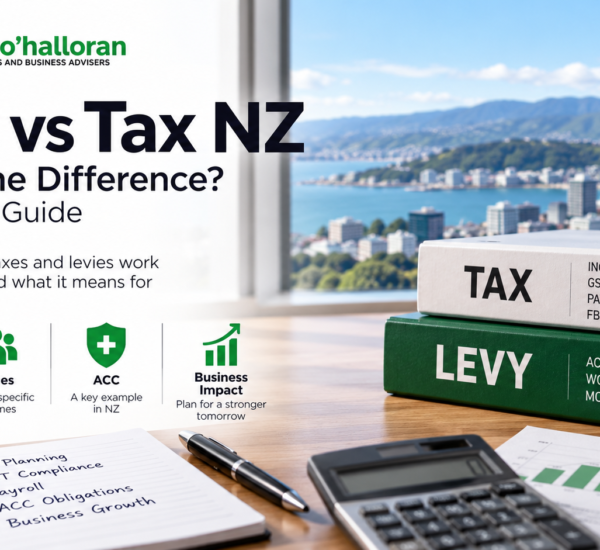
Levy vs tax NZ is an important distinction for businesses because taxes and levies can have different purposes, collection arrangements and financial implications.
Taxes are generally compulsory payments collected under tax legislation to raise government revenue. Levies are generally compulsory charges associated with a particular scheme, service, activity or purpose.
For New Zealand businesses, examples of taxes include income tax, GST and Fringe Benefit Tax, while ACC Work levies are an important example of a business-related levy.
Understanding levy vs tax can help business owners budget for obligations, understand payroll costs and keep their accounting records organised.
Business owners deal with a range of financial obligations throughout the year. Some are taxes, some are levies and others may be fees or regulatory charges. Understanding what each payment represents can make business financial planning easier.
The question of levy vs tax is particularly relevant when reviewing payroll, ACC obligations, business expenses and cash-flow forecasts.
In this guide, DFK Orb360 O’Halloran explains levy vs tax NZ in practical terms and looks at examples that businesses and employers may encounter.
DFK Orb360 O’Halloran provides accounting, tax, GST, payroll and business advisory support for New Zealand businesses.
The simplest way to understand levy vs tax is to consider the purpose of the payment and the system under which it is collected.
| Tax | Levy |
|---|---|
| Generally raises government revenue. | Generally contributes towards a particular scheme, service or purpose. |
| Can apply to income, consumption, employment benefits and other taxable activities. | Can apply to particular people, businesses, activities or schemes. |
| Examples include income tax and GST. | ACC levies are an important New Zealand example. |
| Often administered through Inland Revenue. | Administration depends on the particular levy or scheme. |
The exact legal treatment depends on the particular payment. Businesses should therefore consider the specific rules applying to a tax or levy rather than assuming every government charge works in the same way.
A levy is not necessarily the same as a tax, although both can be compulsory payments established under law.
A tax generally forms part of the government’s broader revenue system, while a levy is commonly associated with a particular scheme, service, activity or purpose.
ACC provides a practical New Zealand example. ACC levies contribute towards the country’s accident compensation system.
This is why the question is a levy a tax needs to be considered in the context of the specific payment involved.
A tax is generally a compulsory payment imposed under tax legislation. Businesses and individuals can have different tax obligations depending on their income, activities, structure and circumstances.
Common New Zealand taxes relevant to businesses include:
The amount and timing of each obligation depend on the applicable tax rules.
A levy is generally a compulsory charge associated with a particular scheme, service, activity or purpose.
One of the most familiar examples for New Zealand employers and businesses is the ACC levy system.
ACC levies can relate to employees, employers, self-employed people and motor vehicles, depending on the relevant circumstances.
Understanding levy vs tax NZ is therefore useful when preparing a complete picture of business costs.
ACC is an important example when looking at levy vs tax in a business context.
Employers can have ACC-related costs associated with their employees and business activities. Self-employed people can also have ACC levy obligations.
These costs are different from income tax, GST and other tax obligations, even though they can all form part of a business owner’s overall financial planning.
The ACC Work levy contributes towards the cost of workplace injury cover. Businesses should factor applicable ACC costs into their employment and operating budgets.
The ACC earners’ levy is generally collected through the PAYE system for employees. It is separate from the income tax component of PAYE.
ACC also has levies associated with motor vehicles and injuries arising from road use.
When looking at tax vs levy NZ, it helps to understand the major taxes a business may encounter.
Businesses can have income tax obligations based on their taxable income and business structure.
GST is a broad-based consumption tax that applies to most taxable supplies in New Zealand, subject to the relevant rules.
Employers generally deduct PAYE from employee payments and pass the required amounts to Inland Revenue.
FBT can apply when employers provide certain non-cash benefits to employees.
Businesses may encounter different levies depending on their activities, employees and assets.
Examples can include:
The relevant levy depends on the nature of the business and the activity involved.
Payroll is one area where the difference between a tax and a levy can become particularly noticeable.
When an employee is paid, the payroll process can involve PAYE and other deductions. The ACC earners’ levy can also be collected through the PAYE system.
This means business owners should understand what each payroll component represents rather than treating every deduction as income tax.
| Payroll Item | General Purpose |
|---|---|
| PAYE | Income tax deductions and related amounts collected through payroll. |
| ACC Earners’ Levy | Contributes towards ACC cover for earners. |
| KiwiSaver | Retirement savings contributions where applicable. |
| Student loan deductions | Payments towards eligible employee student loan obligations. |
Self-employed people need to consider both tax and ACC obligations when planning their finances.
Income tax is calculated according to the individual’s taxable income and applicable rules, while ACC levies can depend on factors such as earnings and business activity.
A business owner should therefore include applicable taxes and levies when preparing a realistic financial forecast.
Understanding levy vs tax is not only about compliance. It can also help businesses prepare more accurate cash-flow forecasts.
A business may need to budget for several obligations throughout the year, including:
Separating these obligations in your financial planning can provide a clearer picture of upcoming cash requirements.
For more information, see our Cash Flow Forecasting NZ guide.
Whether a particular levy is deductible for income tax purposes depends on the nature of the payment and the applicable tax rules.
Businesses should not automatically assume that every levy is deductible simply because it is recorded as a business cost.
If you are uncertain about the tax treatment of a particular levy, discuss it with your accountant or tax adviser before including it in a tax calculation.
Understanding levy vs tax NZ can help business owners make sense of financial statements, payroll reports and government notices.
It can also help when preparing budgets and forecasts because taxes and levies may have different payment arrangements and financial implications.
No. A levy can be compulsory where the relevant rules apply.
No. A levy can have a different purpose and administration from income tax.
No. The ACC earners’ levy is separate from the income tax component, even though it can be collected through the PAYE system.
No. Businesses can have GST, PAYE, ACC and other financial obligations depending on their circumstances.
No. The tax treatment depends on the specific levy and applicable rules.
A practical financial management process can help businesses keep track of their different obligations.
Tax and levy obligations can become more complicated as a business grows. Professional accounting advice can help when the business is dealing with multiple obligations or significant financial decisions.
You may want to speak with an accountant if you are:
Imagine a Wellington business employing several staff members.
The business may need to manage PAYE-related obligations, KiwiSaver contributions where applicable, ACC-related costs and its own business tax obligations.
These payments do not all represent the same type of financial obligation.
This illustrates why understanding levy vs tax can help business owners create more accurate budgets and cash-flow forecasts.
DFK Orb360 O’Halloran provides accounting and business advisory support for New Zealand businesses.
Our services can help businesses manage the financial information behind their tax, GST, payroll and broader business obligations.
If you are unsure about levy vs tax NZ or how different financial obligations affect your business, our team can help you understand the accounting and planning considerations relevant to your circumstances.
From accounting and GST to payroll, tax planning and business advisory, DFK Orb360 O’Halloran can support your business through its financial obligations.
A tax generally raises government revenue, while a levy generally contributes towards a particular scheme, service, activity or purpose.
A levy is not necessarily the same as a tax, although both can be compulsory payments established under law.
Levy vs tax NZ refers to the distinction between general taxation and charges associated with particular schemes or purposes, such as ACC levies.
An ACC levy is a compulsory charge that contributes towards New Zealand’s accident compensation system.
Businesses can have ACC levy obligations, including ACC Work levies, depending on their business activities and circumstances.
No. The ACC earners’ levy is separate from income tax, although it can be collected through the PAYE system.
Examples include income tax, GST, PAYE-related income tax deductions and Fringe Benefit Tax.
Examples include ACC earners’ levies, ACC Work levies and ACC motor vehicle levies.
Self-employed people can have ACC levy obligations based on factors such as their earnings and business activity.
The tax treatment depends on the particular levy and applicable rules, so businesses should check the treatment of specific payments.
Yes. An accountant can help businesses understand their accounting, tax, GST, payroll and levy-related obligations.
Yes. Businesses should include applicable taxes, levies and other financial obligations when preparing cash-flow forecasts and budgets.
DFK Orb360 O’Halloran provides accounting and business advisory support from offices in Auckland and Petone, Lower Hutt, serving businesses across the wider regions.
Understanding levy vs tax can help business owners make better sense of their financial obligations.
Taxes such as income tax and GST generally form part of New Zealand’s taxation system, while levies such as ACC levies are associated with particular schemes and purposes.
For businesses, the practical issue is not simply knowing the difference. It is also understanding which obligations apply, when they need to be paid and how they should be incorporated into accounting and cash-flow planning.
If you are uncertain about a tax, levy or other financial obligation, professional accounting advice can help you understand the rules relevant to your business.
DFK Orb360 O’Halloran helps New Zealand businesses with accounting, tax, GST, payroll, cash-flow forecasting and business advisory.
Talk to our team about your business requirements.
Contact DFK Orb360 O’HalloranThis article provides general information about taxes and levies in New Zealand and is not intended to be financial, tax or legal advice. Tax and levy rules can change, and the treatment of a particular payment depends on the circumstances. Check current official guidance or obtain professional advice before making decisions about your business’s tax obligations.


Copyright © 2025 Marketing Transformers | All Rights Reserved.


 09 377 4238
 Level 2, 6 Kingdon Street, Newmarket, Auckland
 help@orb360.co.nz