

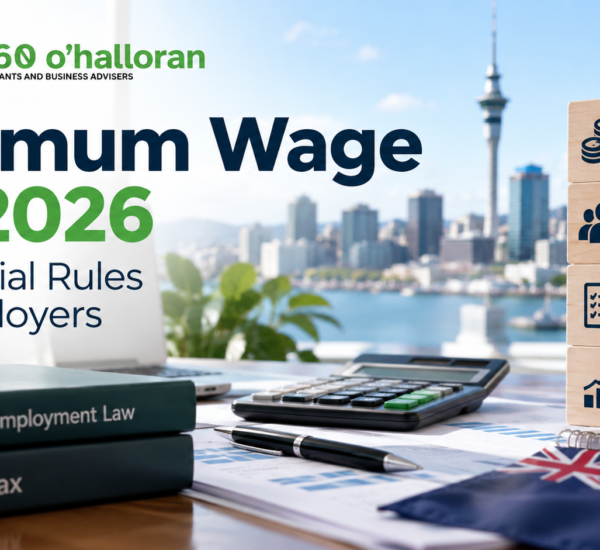
Business Tax & Payroll | New Zealand
Minimum wage NZ rules affect payroll costs, staffing budgets and employment compliance for businesses of every size. Whether you run a small business, hospitality operation, retail store or growing company, understanding the current minimum wage rates can help you plan payroll accurately and meet your obligations as an employer.
What is the minimum wage in New Zealand in 2026?
From 1 April 2026, New Zealand’s adult minimum wage is NZ$23.95 per hour before tax. The starting-out and training minimum wage rates are NZ$19.16 per hour for eligible employees.
These rates apply to each hour worked, subject to the relevant rules and exceptions. Employers should check which minimum wage category applies to each employee and ensure their payroll systems reflect the current rates.
Source: Employment New Zealand — Minimum wage rates and types.
Are rising wage costs putting pressure on your business?
Minimum wage changes can affect payroll, holiday pay, KiwiSaver costs, pricing and cash flow. DFK Orb360 O’Halloran can discuss your accounting and business advisory requirements to help you understand your financial position and plan ahead.
Talk to DFK Orb360What are the current minimum wage rates in NZ?
New Zealand has three main minimum wage rates: adult, starting-out and training. The appropriate rate depends on the employee’s age, work situation and eligibility under the relevant rules.
| Minimum wage category | Hourly rate | Illustrative 40-hour week |
|---|---|---|
| Adult minimum wage | $23.95 | $958.00 |
| Starting-out minimum wage | $19.16 | $766.40 |
| Training minimum wage | $19.16 | $766.40 |
The weekly figures are illustrative gross amounts for 40 hours at the stated hourly rate, before tax and lawful deductions. Actual pay depends on hours worked and the employee’s circumstances.
Who is entitled to the adult minimum wage?
The adult minimum wage generally applies to employees aged 16 and over who do not qualify for the starting-out or training minimum wage. Employees who supervise or train other workers as part of their job must generally receive at least the adult minimum wage.
Employers should not assume that an employee qualifies for a lower rate simply because they are new to the business or receiving on-the-job training. The starting-out and training categories have specific eligibility requirements.
When can the starting-out or training minimum wage apply?
Starting-out minimum wage
The starting-out rate may apply to certain employees aged 16 or 17 during their first six months with an employer, and to certain 18- or 19-year-olds who meet specified benefit and employment-history conditions. It may also apply to eligible young employees undertaking qualifying industry training.
Training minimum wage
The training minimum wage may apply to employees aged 20 or over whose employment agreement requires them to complete at least 60 credits per year in an approved industry training programme to become qualified in their field.
These categories have detailed eligibility conditions. Check the official rules before applying a lower rate to an employee.
Official guidance: Minimum wage rates and types.
How does the minimum wage affect business payroll costs?
The hourly wage is only one part of the cost of employing staff. A minimum wage increase can also affect related employment expenses and the amount of working capital a business needs.
Employers should consider the following areas when reviewing payroll budgets:
- Gross wages: Calculate the impact of updated hourly rates across all relevant employees and shifts.
- Holiday pay and leave: Check how changes in pay affect applicable leave calculations.
- KiwiSaver contributions: Review the employer contribution costs that apply to eligible employees.
- ACC levies: Consider whether changes in payroll affect your expected levy costs.
- Pricing and margins: Assess whether your current prices cover labour and other operating costs.
- Cash flow: Forecast payroll alongside rent, suppliers, tax payments and other business commitments.
Not every cost changes in direct proportion to the minimum wage. The actual effect depends on your workforce, contribution obligations, industry and business structure.
How can employers calculate the impact of minimum wage changes?
A simple first step is to compare the old and new hourly wage costs for the hours your employees work. This provides a starting estimate before you account for other employment-related expenses.
Example: A business employing five workers
Suppose a business has five employees who each work 40 hours per week at the adult minimum wage. At NZ$23.95 per hour, their combined gross wages would be:
- Weekly hours: 5 employees × 40 hours = 200 hours.
- Weekly gross wages: 200 hours × $23.95 = $4,790.
- Annualised gross wages: $4,790 × 52 weeks = $249,080.
This illustration assumes all five employees are eligible for the adult minimum wage and work 40 paid hours every week for 52 weeks. It excludes leave-related adjustments, employer contributions, ACC levies, overtime and other employment costs.
To estimate the effect of a wage change, multiply the difference between the old and new hourly rates by the relevant paid hours. Then update the broader payroll budget to reflect the costs applicable to your business.
What should employers do to prepare for minimum wage changes?
- Review employee pay rates. Identify employees whose pay may be affected by the applicable minimum wage rate.
- Check payroll software. Ensure your payroll system uses the correct rates from the effective date.
- Update employment records. Keep accurate records of hours worked, wages payable, wages paid and leave taken.
- Review budgets. Forecast the impact of wage changes on labour costs, pricing and cash flow.
- Check related obligations. Review applicable holiday pay, KiwiSaver, PAYE and ACC requirements with the appropriate adviser.
- Communicate clearly. Ensure employees understand any changes to their pay and that employment agreements and payroll records are consistent with the law.
What happens if a business pays less than the minimum wage?
Employers must generally pay employees at least the applicable minimum wage for every hour worked. Minimum wage compliance cannot simply be averaged across a season or a longer period to compensate for underpayment in other weeks.
Employers should keep accurate wage and time records and review any situation where an employee’s effective hourly pay may fall below the required rate. If you identify a possible underpayment, seek appropriate employment or legal advice and address the issue promptly.
The official Employment New Zealand website explains minimum wage requirements, exceptions and record-keeping obligations: Read the minimum wage guidance.
How can an accountant help with wage costs and business planning?
An accountant can help business owners understand how wage costs affect profitability and financial planning. Depending on the services agreed, support may include:
- Reviewing payroll costs in management accounts.
- Forecasting cash flow after changes in employment costs.
- Assessing labour costs against revenue and gross margins.
- Preparing budgets and financial scenarios for different staffing levels.
- Helping business owners understand how payroll costs interact with tax and other financial commitments.
Accounting support does not replace employment-law or payroll-specialist advice where that is required. Businesses should confirm that the provider offers the specific service they need.
Need a clearer picture of your business costs?
Understanding wage costs is important when setting prices, planning recruitment and protecting profitability. DFK Orb360 O’Halloran can discuss your accounting and business advisory needs and help you identify appropriate next steps.
Tell us about your business and the financial challenges you’re working through.
Contact DFK Orb360People Also Ask: Minimum Wage NZ
What is the minimum wage in NZ in 2026?
From 1 April 2026, New Zealand’s adult minimum wage is NZ$23.95 per hour before tax. The starting-out and training minimum wage rates are NZ$19.16 per hour for eligible employees.
When did the minimum wage increase in New Zealand in 2026?
The 2026 minimum wage rates took effect on 1 April 2026. Employers should use the applicable rate for each employee based on their eligibility and the hours worked.
Is minimum wage in NZ before or after tax?
Minimum wage rates are stated before tax and lawful deductions. An employee’s take-home pay may be lower after PAYE and other applicable deductions.
What is the minimum wage for a 16-year-old in NZ?
A 16-year-old may qualify for the starting-out minimum wage if the eligibility conditions are met. The starting-out rate is NZ$19.16 per hour from 1 April 2026. The adult minimum wage generally applies when the employee does not qualify for a lower statutory rate.
What is the minimum wage for apprentices in NZ?
Eligible apprentices may qualify for the training minimum wage of NZ$19.16 per hour from 1 April 2026 if they meet the requirements for an approved industry training programme and their employment agreement. Not every employee receiving workplace training qualifies.
Do employers have to pay minimum wage for overtime in NZ?
Employees must generally receive at least the applicable minimum wage for every hour worked, including additional hours. Specific employment agreements may provide higher overtime rates, and other employment requirements may apply.
How can NZ businesses manage rising minimum wage costs?
Businesses can review staffing budgets, forecast cash flow, assess labour costs against revenue, review pricing and update payroll systems. An accountant or business adviser may help assess the financial effect of wage changes and develop an appropriate budget.
Can DFK Orb360 help businesses plan for payroll cost increases?
DFK Orb360 O’Halloran provides accounting, tax and business advisory support. Business owners can contact the team to discuss financial reporting, budgeting and cash flow planning and confirm which services are available for their requirements.
Plan ahead for your business’s employment costs
Need help understanding how wage costs affect your profitability, cash flow or business budget? Speak with DFK Orb360 O’Halloran about your accounting and business advisory needs.
Discuss Your Business NeedsPeople Also Ask: Minimum Wage NZ 2026 – FAQs for Employees and Employers
Understanding minimum wage NZ requirements is essential for businesses managing payroll, employment costs and wage compliance. These frequently asked questions explain current New Zealand minimum wage rates, employer obligations and how DFK Orb360 can support business financial planning.
1. What is the minimum wage NZ rate in 2026?
The minimum wage NZ adult rate is $23.95 per hour before tax from 1 April 2026. Eligible employees receiving the starting-out or training minimum wage must receive at least $19.16 per hour. Employers should confirm which rate applies to each employee and update their payroll records accordingly.
2. How much is the minimum wage NZ per week?
At the adult minimum wage NZ rate of $23.95 per hour, an employee working 40 paid hours per week earns $958 gross per week. This equals $49,816 over 52 weeks, assuming the employee works 40 paid hours every week at the same rate. Actual earnings depend on hours worked, leave arrangements and other employment conditions.
3. When did the minimum wage NZ increase in 2026?
The minimum wage NZ rates increased on 1 April 2026. Employers should ensure eligible employees receive at least the applicable rate for hours worked from the effective date. Businesses should also review staffing budgets and payroll calculations when wage rates change.
4. What is the minimum wage NZ after tax?
The minimum wage NZ rate is quoted before PAYE and other applicable deductions. Take-home pay depends on the employee’s tax code, hours worked, KiwiSaver contributions and other circumstances. Employees can use Inland Revenue’s PAYE calculator to estimate deductions and net earnings.
5. What is the minimum wage NZ for 16-year-olds?
Some employees aged 16 or 17 may qualify for the starting-out minimum wage of $19.16 per hour from 1 April 2026. However, eligibility conditions apply, and the adult minimum wage may be required in other circumstances. Employers should check Employment New Zealand guidance before applying the starting-out rate.
6. Does minimum wage NZ apply to part-time and casual workers?
Yes. Employees working part-time or casual hours are generally entitled to at least the applicable minimum wage NZ rate for every hour worked. Employment type does not automatically remove minimum wage obligations. Employers must also comply with applicable leave and employment rules.
7. Can employers pay below the minimum wage NZ?
Employers generally cannot pay employees below the applicable minimum wage NZ rate. Lower starting-out or training rates apply only when the employee meets the relevant legal conditions. Limited statutory exceptions may apply. Employers should seek appropriate employment advice if they are uncertain about eligibility.
8. How does the minimum wage NZ affect small businesses?
Changes to the minimum wage NZ can increase staffing expenses and affect business cash flow, pricing and profitability. Small business owners should review wage budgets, employment costs, gross margins and financial forecasts. DFK Orb360 can discuss accounting and business advisory support to help businesses understand their financial position.
9. Does the minimum wage NZ affect PAYE and KiwiSaver?
Higher gross wages can affect PAYE deductions and KiwiSaver contribution amounts. Employers must calculate payroll deductions and contributions according to current Inland Revenue rules. Businesses should review their payroll processes and forecast applicable employment-related costs.
10. How can employers prepare for future minimum wage NZ changes?
Employers can prepare for minimum wage NZ changes by reviewing employee pay rates, forecasting labour costs, updating payroll systems and monitoring official announcements. Financial planning can help businesses understand how potential wage increases may affect staffing decisions, cash flow and profitability.
11. Can an accountant help businesses manage minimum wage costs in NZ?
Yes. An accountant or business adviser can help businesses analyse wage expenses, prepare cash flow forecasts, review profitability and plan for changing employment costs. DFK Orb360 O’Halloran provides accounting and business advisory services for New Zealand businesses. Contact the team to discuss your requirements.
12. Why choose DFK Orb360 for business financial planning in NZ?
DFK Orb360 O’Halloran provides accounting, tax and business advisory support to New Zealand businesses. If changes to minimum wage NZ rates are affecting your staffing budget, profitability or cash flow, DFK Orb360 can discuss your financial reporting and business planning needs.
Are Rising Wage Costs Affecting Your Business Profitability?
Minimum wage NZ changes can affect more than employee pay. They can influence operating costs, business margins and future growth decisions.
Get financial clarity before wage costs put additional pressure on your business.
Speak with DFK Orb360 O’Halloran about business accounting, cash flow forecasting and financial planning support.
Talk to a DFK Orb360 Business AdviserOfficial sources and further guidance
- Employment New Zealand: Minimum wage rates and types
- Business.govt.nz: Minimum wages increase from 1 April 2026
- Business.govt.nz: Minimum wage and fair pay
Speak to DFK Orb360 O’Halloran
DFK Orb360 O’Halloran provides accounting, tax and business advisory support to businesses across New Zealand. If you need help understanding your financial performance, budgeting or cash flow, contact the team to discuss your business requirements.
Author: DFK Orb360 Team
Reviewed by: DFK Orb360 Team
Last reviewed: 26 October 2026
Disclaimer: This article provides general information and is not employment, legal, tax or accounting advice for a specific situation. Minimum wage rules can change, and eligibility depends on individual circumstances. Check current Employment New Zealand guidance or seek appropriate professional advice before making payroll decisions.


 09 377 4238
 Level 2, 6 Kingdon Street, Newmarket, Auckland
 help@orb360.co.nz