

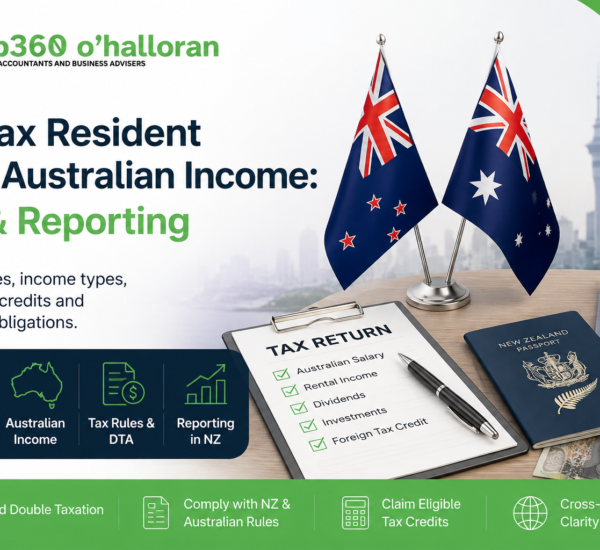
NZ Tax Resident With Australian Income: Tax & Reporting
If you are a NZ tax resident with Australian income, you may have tax and reporting obligations in both countries. Australian salary, rental income, dividends, business income, superannuation and certain investment income can require careful consideration under New Zealand tax rules.
New Zealand tax residents are generally taxed on their worldwide income, which means Australian income may need to be included in your New Zealand tax return even if the income remains in Australia or Australian tax has already been deducted.
The good news is that New Zealand’s foreign tax credit rules and the Australia–New Zealand Double Tax Agreement can provide relief where the same income is taxed in both countries. The exact treatment depends on the type of income, your tax residency position and the relevant treaty provisions.
NZ Tax Resident With Australian Income
A NZ tax resident with Australian income will generally need to consider that income when completing their New Zealand tax obligations. New Zealand generally taxes residents on worldwide income, including income earned from Australia. Australian tax paid may, in eligible circumstances, be available as a foreign tax credit in New Zealand.
The Australia–New Zealand Double Tax Agreement can affect which country has the right to tax particular types of income and how double taxation is relieved. The correct treatment depends on whether the income is employment income, rental income, dividends, business income, investment income, superannuation or another type of overseas income.
Do NZ Tax Residents Pay Tax on Australian Income?
Generally, yes. If you are a NZ tax resident with Australian income, New Zealand will generally expect you to account for your worldwide taxable income.
This means Australian income does not automatically become exempt from New Zealand tax simply because it was earned in Australia, paid into an Australian bank account or taxed by the Australian Taxation Office.
Inland Revenue states that New Zealand tax residents generally pay tax on worldwide income, including overseas income that has not been transferred to New Zealand. Foreign tax paid may be relevant when determining whether a foreign tax credit can be claimed.
Therefore, the first question for a NZ tax resident with Australian income is not simply whether Australian tax has already been paid. The correct approach is to identify the income, determine the applicable New Zealand tax treatment and then consider the Australia–New Zealand tax rules.
What Australian Income Does a NZ Tax Resident Need to Report?
The type of Australian income you receive can determine how it is treated in New Zealand. Common examples include:
- Australian employment income and salary
- Australian rental income
- Australian dividends
- Australian bank interest
- Business or contracting income earned in Australia
- Capital gains from certain Australian assets
- Australian pensions or superannuation payments
- Income from Australian investments
A NZ tax resident with Australian income should keep records for each income category rather than treating all Australian receipts as one combined amount.
This distinction is important because different types of overseas income can be subject to different New Zealand rules, and the Australia–New Zealand Double Tax Agreement can apply differently depending on the nature of the income.
Australian Salary for a NZ Tax Resident
If you live in New Zealand but receive salary from an Australian employer, the tax treatment depends on the circumstances of your employment and where the employment services are performed.
For a NZ tax resident with Australian income, it is important to establish where the work was physically performed, whether you travelled between New Zealand and Australia, who the employer is and whether Australian tax was deducted.
Australian employment income may therefore require analysis in both jurisdictions. You should not assume that the country paying the salary is automatically the only country entitled to tax it.
Where the same employment income is taxed in both countries, the Australia–New Zealand tax rules and foreign tax credit provisions may help prevent double taxation.
Australian Rental Income for NZ Tax Residents
Australian rental property is another common situation for a NZ tax resident with Australian income.
If you own a residential or commercial property in Australia and receive rental income, you may have Australian tax obligations because the income arises from Australian property.
You may also need to consider the rental income under New Zealand tax rules because you are a New Zealand tax resident.
The New Zealand treatment of overseas rental income should be considered separately from the Australian return. Records of Australian rental income, allowable expenses, Australian tax paid and currency conversion should be retained.
Inland Revenue also distinguishes overseas residential rental income from some other categories of overseas income when completing the New Zealand tax return. The correct reporting method should therefore be checked based on the property and income involved.
Australian Dividends and Interest
Australian dividends and interest can also form part of the worldwide income of a NZ tax resident with Australian income.
For example, if you maintain Australian bank accounts after moving to New Zealand, the interest earned may need to be considered in your New Zealand tax return.
Similarly, Australian company dividends may need to be considered under New Zealand’s rules for foreign investment income. Depending on the investment, different rules can apply.
This is why simply converting the amount received in Australian dollars into New Zealand dollars is not always enough. The applicable income category and tax rules need to be established first.
Australian Shares and Investments
If you are a NZ tax resident with Australian income and hold Australian shares or other investments, the New Zealand tax treatment can depend on the nature and size of your investment.
Some foreign investments may be subject to the Foreign Investment Fund (FIF) rules, while other investments may be treated under ordinary income tax rules or specific exemptions.
You should therefore determine the correct New Zealand treatment before reporting dividends, investment gains or other returns from Australian assets.
Where Australian tax has been paid, the potential foreign tax credit should also be considered separately from the underlying New Zealand tax treatment.
Australian Superannuation and Pension Income
Australian superannuation can create additional complexity for a NZ tax resident with Australian income.
The tax treatment can depend on when the superannuation interest was acquired, your residency history, the type of payment and whether you are receiving a pension, lump sum or another form of benefit.
Australian superannuation should therefore not automatically be treated as ordinary salary or investment income in your New Zealand return.
If you moved from Australia to New Zealand and retained an Australian superannuation interest, reviewing the history of the investment and your residency status can be particularly important.
Australia–New Zealand Double Tax Agreement
The Australia–New Zealand Double Tax Agreement, commonly referred to as the DTA, is designed to address situations where income has connections with both countries.
For a NZ tax resident with Australian income, the DTA may affect which country has taxing rights over particular categories of income. It can also provide mechanisms for reducing or eliminating double taxation.
The treaty does not mean that every Australian income source is automatically tax-free in New Zealand. The relevant article of the DTA needs to be considered alongside New Zealand’s domestic tax rules.
If you believe you are resident for tax purposes in both Australia and New Zealand, additional treaty residency rules may also become relevant.
Can a NZ Tax Resident Claim Australian Tax Paid?
Potentially. A NZ tax resident with Australian income may be able to claim a foreign tax credit in New Zealand where Australian tax has been paid on income that is also subject to New Zealand tax.
The amount of credit is not necessarily equal to every dollar of Australian tax paid. Inland Revenue explains that foreign tax credits are subject to limits, including the amount of New Zealand tax attributable to the same income and any applicable treaty limitation.
You should also retain evidence of the Australian tax paid because supporting documentation may be required when claiming the credit.
How to Report Australian Income in Your NZ Tax Return
A NZ tax resident with Australian income may need to include the relevant income in their Individual tax return, known as the IR3.
For overseas income, Inland Revenue also requires an Overseas income summary, IR1261, for tax years from 2023 onwards.
The IR1261 requires information about the type of overseas income, the amount, the overseas jurisdiction and foreign tax credits being claimed.
This means your Australian income should be organised by income type and supported by appropriate records before completing your New Zealand tax return.
Currency Conversion for Australian Income
Australian income will normally be received in Australian dollars, while your New Zealand tax return is completed using New Zealand dollars.
A NZ tax resident with Australian income therefore needs to consider the appropriate foreign currency conversion method when calculating the NZ-dollar amount to report.
Do not simply use an arbitrary exchange rate. Keep records showing the amounts received, relevant dates and the exchange-rate method used for the New Zealand tax calculation.
What Records Should You Keep?
Good record keeping can make Australian income reporting significantly easier.
A NZ tax resident with Australian income should consider keeping:
- Australian payslips and payment summaries
- Australian tax assessments
- ATO correspondence
- Australian bank statements
- Rental income and expense records
- Dividend statements
- Investment transaction records
- Superannuation statements
- Evidence of Australian tax paid
- Foreign currency conversion records
- Documents supporting foreign tax credit calculations
Keeping these documents together can help support both your Australian and New Zealand tax reporting.
Do You Need to File a Tax Return in Australia?
Being a New Zealand tax resident does not automatically mean you have no Australian tax obligations.
Australia can still tax certain Australian-source income received by non-residents. The Australian Taxation Office states that foreign residents generally need to declare Australian-source income such as employment income, rental income and certain capital gains on taxable Australian property.
However, the Australian treatment of interest, dividends and royalties can differ, particularly where withholding tax applies.
A NZ tax resident with Australian income should therefore consider both the Australian filing requirements and the New Zealand reporting requirements rather than assuming that filing in one country satisfies the obligations of the other.
What If You Recently Moved From Australia to New Zealand?
Moving from Australia to New Zealand can create a transition period where your tax residency position needs to be established carefully.
The date you became a New Zealand tax resident can affect which overseas income needs to be reported in New Zealand.
Inland Revenue explains that when someone becomes a New Zealand tax resident during a tax year, the tax return needs to distinguish between income earned before becoming resident and income earned while a New Zealand tax resident.
Some new or returning New Zealand tax residents may also qualify for a temporary exemption on certain foreign income for approximately four years, subject to the applicable conditions.
This exemption should not be assumed to apply automatically. Your residency history and the nature of your Australian income need to be reviewed.
New Zealand tax residents generally pay tax on their worldwide income, including income earned from Australia. Inland Revenue provides detailed guidance on tax for New Zealand tax residents, including overseas income and foreign tax credits.
You should also check your Australian obligations based on the type of income you receive. The Australian Taxation Office provides guidance on income that must be declared in Australia.
The Australia–New Zealand Double Tax Agreement can affect how particular types of income are taxed between the two countries. Inland Revenue provides the current Australia–New Zealand tax treaty information for taxpayers and advisers.
What If You Are a Tax Resident of Both Countries?
It is possible for an individual to be treated as a tax resident under the domestic rules of both New Zealand and Australia.
If this happens, the Australia–New Zealand DTA may contain tie-breaker rules for determining residence for treaty purposes.
However, being treated as a treaty resident of one country does not necessarily erase all domestic tax obligations in the other country.
For a NZ tax resident with Australian income, dual-residency situations should be reviewed carefully before filing either country’s tax return.
Common Mistakes NZ Tax Residents Make With Australian Income
1. Assuming Australian tax means no NZ tax
Paying tax in Australia does not automatically remove your New Zealand tax obligations. The foreign tax credit and treaty rules need to be considered.
2. Not reporting income kept in Australia
A NZ tax resident with Australian income generally cannot avoid New Zealand reporting simply because the money remains in an Australian bank account.
3. Treating all Australian income the same
Salary, rent, dividends, interest, superannuation and investment income can have different tax treatments.
4. Using the wrong exchange rate
Australian-dollar income needs to be appropriately converted when preparing your New Zealand tax calculations.
5. Claiming the wrong foreign tax credit
The amount of Australian tax paid is not necessarily the amount that can be claimed as a New Zealand foreign tax credit.
6. Ignoring the DTA
The Australia–New Zealand Double Tax Agreement can affect taxing rights and double-tax relief for particular types of income.
NZ Tax Resident With Australian Income: Practical Checklist
If you are a NZ tax resident with Australian income, work through the following checklist before filing your New Zealand tax return:
- Confirm your New Zealand tax residency status.
- Confirm whether you have any Australian tax residency issues.
- List every Australian income source.
- Separate salary, rent, dividends, interest, investments and pensions.
- Calculate the income in New Zealand dollars using an appropriate method.
- Determine the applicable New Zealand tax treatment.
- Check whether the Australia–New Zealand DTA affects the income.
- Calculate any available foreign tax credit.
- Keep evidence of Australian tax paid.
- Complete the relevant New Zealand tax return and overseas income reporting.
If you have income, investments or business interests across Australia and New Zealand, DFK Orb360 O’Halloran can help you understand the broader cross-border considerations through our International Business Services.
When Should You Get Professional Advice?
Professional advice can be particularly useful if you are a NZ tax resident with Australian income and have multiple income sources, Australian property, a business, significant investments, superannuation or potential dual-tax residency.
The interaction between New Zealand’s domestic tax rules, Australian tax rules and the Australia–New Zealand DTA can make cross-border tax reporting more complicated than a standard individual tax return.
Getting the structure and reporting position reviewed before filing can also help identify foreign tax credits, reporting obligations and potential issues that may otherwise be missed.
Get Help With Australian Income and NZ Tax
Are you a NZ tax resident with Australian income and unsure what needs to be reported in New Zealand?
DFK Orb360 O’Halloran can assist with accounting, tax compliance and international tax matters for New Zealand individuals and businesses with overseas income and interests.
If you receive Australian salary, rental income, investment income, superannuation or other Australian-source income, our team can help you understand the New Zealand reporting requirements and consider the interaction with Australian tax.
Need help with your Australian income? Contact DFK Orb360 O’Halloran to discuss your New Zealand tax and reporting requirements.
Frequently Asked Questions
Do NZ tax residents pay tax on Australian income?
Generally, yes. New Zealand tax residents are generally taxed on their worldwide income, which can include income earned from Australia. Australian tax paid may potentially qualify for a foreign tax credit, subject to the applicable rules.
Do I have to declare Australian income in my NZ tax return?
Generally, yes, if you are a New Zealand tax resident and the Australian income is taxable in New Zealand. Overseas income is generally reported through the relevant sections of the IR3, with an Overseas income summary (IR1261) also required for relevant overseas income.
Can I claim Australian tax paid in New Zealand?
You may be able to claim a foreign tax credit for eligible Australian tax paid on income that is also taxable in New Zealand. The credit is subject to specific limits and requirements.
What Australian income must a NZ tax resident report?
Depending on your circumstances, this can include Australian salary, rental income, interest, dividends, business income, investment income, superannuation or pension income and certain capital gains.
Does the Australia–New Zealand DTA prevent double taxation?
The Australia–New Zealand Double Tax Agreement can allocate taxing rights over certain types of income and provide mechanisms for relieving double taxation. The applicable treaty provisions depend on the type of income and your residency circumstances.
What if I live in New Zealand but work for an Australian company?
The answer depends on where the employment services are performed, your residency position, the employer’s circumstances and the applicable treaty rules. The Australian and New Zealand tax positions should be reviewed together.
Do I need an Australian tax return if I live in New Zealand?
Possibly. Australian tax obligations can continue to apply to certain Australian-source income even if you are a foreign resident for Australian tax purposes. The requirement depends on your income and circumstances.
What happens if I am tax resident in both Australia and New Zealand?
You may need to consider the Australia–New Zealand Double Tax Agreement’s residency provisions. Treaty tie-breaker rules can determine residence for treaty purposes, but domestic obligations can still require separate analysis.
Key Takeaway
Being a NZ tax resident with Australian income does not necessarily mean you will pay tax twice on the same income. However, you should not assume that Australian tax automatically satisfies your New Zealand obligations.
The correct approach is to identify each Australian income source, determine the New Zealand tax treatment, consider the Australia–New Zealand Double Tax Agreement and calculate any eligible foreign tax credit.
If your Australian income includes property, investments, business interests or superannuation, professional advice can help ensure that your New Zealand tax return accurately reflects your international tax position.
Disclaimer: This article is general educational information and does not constitute personalised tax, accounting or legal advice. Tax treatment can vary according to individual circumstances, residency status, income type and changes to New Zealand or Australian tax law.
Reviewed: September 2026



 09 377 4238
 Level 2, 6 Kingdon Street, Newmarket, Auckland
 help@orb360.co.nz