

TAX & BUSINESS ADVISORY
Provisional Tax NZ: New IRD Payment Changes Explained
What New Zealand businesses need to know about Inland Revenue’s new payment and refund process from 6 October 2026.
Provisional Tax NZ: What Has Changed?
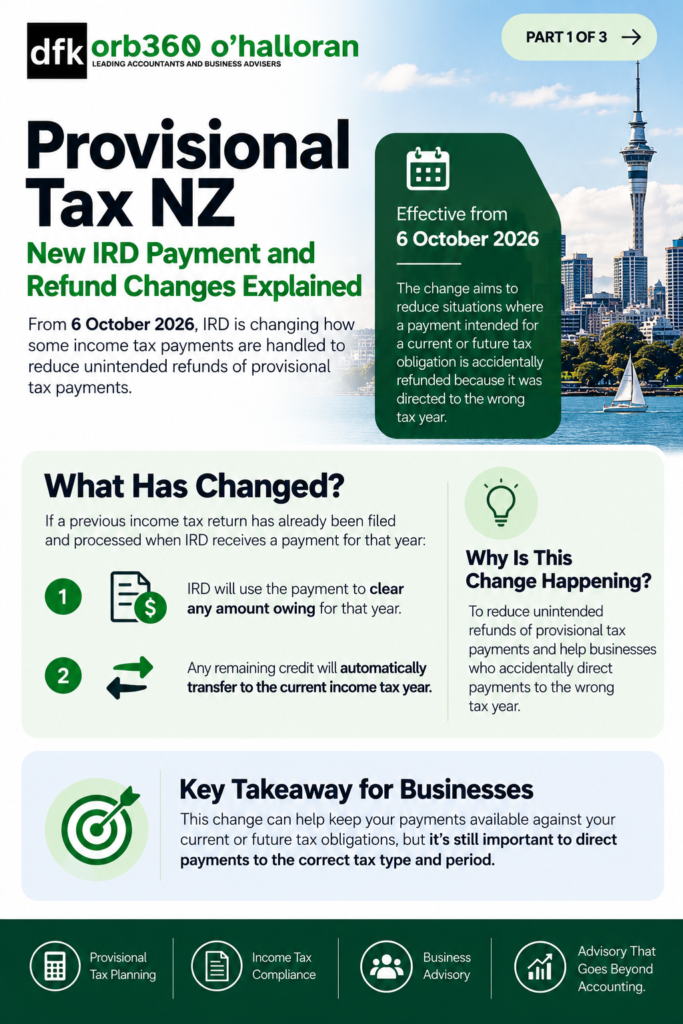
From 6 October 2026, Inland Revenue has introduced a new process for certain payments made to a previous income tax year after that year’s return has already been filed and processed.
Where the conditions are met, IRD will first use the payment to clear any amount owing for the previous year and automatically transfer any remaining credit to the current income tax year.
However, businesses should still make payments to the correct tax year and tax type. The new process does not mean every excess tax payment will automatically move to the following year.
What Has Changed for Provisional Tax in NZ?
From 6 October 2026, IRD has changed how certain income tax payments are handled.
The change applies when:
- A business makes a payment for a previous income tax year.
- The previous year’s income tax return has already been filed.
- The return has already been processed when IRD receives the payment.
When these conditions are met, IRD will:
The purpose is to reduce situations where a payment is accidentally made to the wrong year and the resulting credit is subsequently refunded, even though the business may have intended the funds to cover a current or future tax obligation.
How Does the New IRD Payment Process Work?
Let’s look at a simple example.
Suppose 2027 is the current income tax year.
A business has already filed and had its 2026 income tax return processed.
The business then makes a $10,000 payment to the 2026 income tax year.
It still has $8,000 owing for 2026.
Illustrative Example: $10,000 Payment
| Payment | Amount |
|---|---|
| Payment received | $10,000 |
| 2026 income tax owing | $8,000 |
| Applied to 2026 | $8,000 |
| Remaining credit | $2,000 |
| Automatically transferred to 2027 | $2,000 |
The remaining $2,000 credit can automatically transfer to the current 2027 income tax year, provided the conditions for the new rule are met.
The important point is that this isn’t a general rule that allows businesses to pay any tax obligation into any year and rely on IRD to move the money later.
Correct payment allocation remains important.
Does Every Excess Tax Payment Automatically Transfer?
The automatic transfer only applies in specific circumstances.
The automatic transfer applies when the previous year’s income tax return has already been processed when IRD receives the payment.
If the previous year’s return has not yet been processed, the automatic transfer will not occur.
Instead, the resulting credit may be dealt with through IRD’s standard processes, which can include:
- Debt offset
- Nominated transfer
- Refund processes
The credit may be refunded once the return has been processed.
What Does This Mean for Your Business?
Don’t assume that an incorrectly allocated payment will automatically end up where you need it.
Check your IRD account and correct payment errors when necessary.
Why Paying the Correct Tax Year Still Matters
The new process provides an additional safeguard in certain circumstances, but making payments against the correct tax type and period remains important.
This becomes particularly relevant when a business has several tax obligations at the same time.
For example, a business might have:
- An outstanding 2026 income tax liability
- A 2027 provisional tax obligation
These are separate payment obligations.
Our Practical Recommendation
If you’re intending to cover both, make separate payments:
Payment 1: 2026 income tax liability
Payment 2: 2027 provisional tax obligation
This makes the intended allocation clearer and reduces the risk of an incorrect payment allocation.
Does the New Rule Apply to Older Tax Years?
The automatic transfer applies only between:
- The current income tax year
- The previous income tax year
In other words, the previous year means current year minus one.
The change does not automatically apply to older income tax years.
Businesses should therefore not assume that a credit relating to an older tax year will automatically transfer into the current year.
What If You Paid the Wrong Tax Year?
If you’ve accidentally directed a payment to the wrong tax period or tax type, the new automatic transfer process does not replace the existing process for correcting payment allocation.
The Financial transfers service in the Intermediary centre in myIR can be used to transfer a payment where appropriate.
If you notice an incorrectly allocated payment, don’t simply assume that the new automatic transfer rule will resolve it.
What Is Provisional Tax in New Zealand?
Provisional tax in NZ is a way of paying income tax during the year rather than waiting until the end of the tax year to pay the full amount.
Businesses and other taxpayers who meet the relevant requirements may need to make provisional tax payments during the year.
These payments can help spread income tax obligations throughout the year and support cash-flow management.
This makes understanding your tax position and payment timing an important part of financial planning.
Why This Change Matters for Business Cash Flow
Tax payments aren’t just a compliance issue. They can also affect how a business manages its cash reserves and upcoming financial commitments.
If a payment is incorrectly allocated or refunded, a business may later need to find those funds again to meet its tax obligations.
Regularly reviewing your IRD account can help identify:
- Outstanding tax
- Available credits
- Incorrect payment allocations
- Upcoming tax obligations
- Potential cash-flow requirements
Regularly reviewing your IRD account can help identify outstanding tax, available credits, incorrect payment allocations and upcoming cash-flow requirements. For broader financial planning and business decision-making, our business advisory services in Auckland can help you understand your financial position and plan ahead.
A Simple Habit Can Help
Before making a significant tax payment, check:
Which tax type? → Which tax year? → How much is owing? → What obligations are coming next?
5 Things Businesses Should Do Now
Check the Tax Period Before Making a Payment
Confirm the income tax year and tax type the payment is intended to cover.
Separate Different Tax Obligations
If you’re paying an existing income tax liability as well as a future provisional tax obligation, make separate payments.
Review Your IRD Account
Check that recent payments have been allocated correctly.
Correct Payment Errors
If a payment has gone to the wrong period or tax type, use the appropriate transfer process.
Don’t Rely Entirely on Automatic Transfers
The new rule is designed to reduce certain unintended refunds, but it does not cover every payment situation.
What Does This Mean for Your Business?
The practical message is straightforward:
The new IRD process provides an additional safeguard, but accurate tax payment planning still matters.
Businesses should continue to understand their provisional tax obligations, monitor their IRD accounts and consider upcoming tax payments when planning cash flow.
For businesses with multiple tax obligations, this can become particularly important because payment timing and allocation can affect the funds available for other business expenses.
EXPERT REVIEW
Reviewed by Riz Khan, CPA
Riz Khan, CPA | Associate Partner
Riz is a CPA and Associate Partner at DFK Orb360 O’Halloran, with more than a decade of experience in accounting, taxation and business advisory.
How DFK Orb360 Can Help With Provisional Tax
Managing provisional tax in NZ involves more than simply making payments when they’re due.
Businesses also need to consider their expected tax position, payment timing, cash flow and upcoming obligations.
DFK Orb360 O’Halloran can support businesses with:
- Provisional tax planning
- Income tax compliance
- Tax payment planning
- GST and tax support
- Financial reporting
- Cash-flow planning
- Business advisory
- Ongoing accounting support
Our approach brings together accounting, tax and business advisory to help business owners make informed financial decisions.
FAQs About Provisional Tax NZ
What changed to provisional tax payments from 6 October 2026?
For certain payments made to a previous income tax year after that year’s return has been filed and processed, IRD will first clear any amount owing for that year and then automatically transfer any remaining credit to the current income tax year.
Will every excess tax payment automatically move to the next year?
No. The automatic transfer only applies when the previous year’s income tax return has already been processed when IRD receives the payment.
Should I make separate payments for different tax years?
Yes. If you want to cover a previous income tax liability and a current or future provisional tax obligation, separate payments for each relevant period make the intended allocation clearer.
Does the new rule apply to older tax years?
No. The automatic transfer applies only between the current income tax year and the previous income tax year.
What should I do if I paid the wrong tax year?
Review your IRD account and use the appropriate payment transfer process. The Financial transfers service in the Intermediary centre in myIR can be used to transfer payments where appropriate.
Why is correct payment allocation important?
Correct allocation helps ensure payments are applied to the intended tax obligation and can form part of effective tax and cash-flow management.
Key Takeaways
The new IRD payment process is intended to reduce unintended refunds of certain provisional tax payments.
Businesses should remember:
- The change starts from 6 October 2026.
- It applies only in specific circumstances.
- The previous year’s return must already have been filed and processed.
- Remaining credits may automatically transfer to the current year.
- Older tax years are not covered.
- Businesses should still make payments to the correct tax year and tax type.
- Separate payments are recommended when covering different tax obligations.
- Businesses should regularly review their IRD account.
Final Thought
The latest IRD change may make certain payment situations easier to manage, but it shouldn’t replace good tax planning.
For businesses, the best approach remains simple:
If you’re unsure how the new process affects your business or provisional tax position, getting advice before making a significant payment can help you make a more informed decision.
DFK Orb360 O’Halloran — Advisory That Goes Beyond Accounting.
Need Help Planning Your Provisional Tax?
Understanding your tax obligations is an important part of managing your business cash flow.
Our team can help you understand your tax position, plan upcoming payments and make informed financial decisions.
Talk to a Business Advisor
Tell us a little about your business and what you’d like help with. Our team will get in touch.
Official Information
For the latest information about provisional tax and tax payment processes, refer to Inland Revenue’s official guidance.


 09 377 4238
 Level 2, 6 Kingdon Street, Newmarket, Auckland
 help@orb360.co.nz