
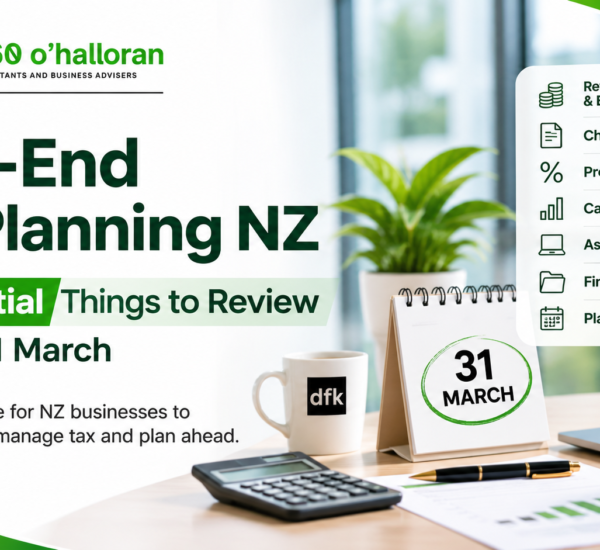
Is your business financially prepared for the end of the tax year? For New Zealand business owners, preparing ahead of 31 March can make a significant difference to tax compliance, cash flow management and financial decision-making.
The end of the financial year is an opportunity to review business income, expenses, outstanding invoices, tax obligations and financial records. It is also a good time to identify potential issues before they become more difficult to resolve.
Effective Year-End Tax Planning NZ involves more than preparing your annual tax return. It means understanding your business’s financial position, checking that your records are accurate and considering the tax implications of important business decisions.
Year-end tax planning is the process of reviewing a business’s income, expenses, tax obligations, financial records and assets before the end of its financial year. For businesses using the standard 31 March balance date, this preparation helps identify outstanding matters and organise information needed for tax reporting.
New Zealand businesses should review deductible expenses, GST and PAYE obligations, provisional tax, outstanding customer payments, business assets, depreciation and financial records. Business owners should also consider cash flow and upcoming tax payments.
Working with an accountant can help identify relevant tax considerations, check compliance requirements and prepare for the next financial year.
For most New Zealand businesses, the standard balance date is 31 March. This means the financial year generally runs from 1 April to 31 March, although some businesses have an approved or otherwise applicable non-standard balance date.
Preparing early gives business owners time to review financial information, identify missing records and discuss tax matters with their accountant.
Good Year-End Tax Planning NZ can help businesses:
Rather than waiting until the tax return is due, use the months leading up to 31 March to review your business finances and address outstanding questions.
Start by reviewing your business income and expenses for the financial year. Check that sales, service income, supplier costs and operating expenses have been recorded accurately.
Look for missing invoices, duplicated transactions, incorrectly categorised expenses and personal transactions recorded through business accounts.
Common business expense categories may include:
Not every payment made by a business is automatically tax deductible. Expenses must meet the relevant tax requirements, and private or capital expenditure may receive different treatment.
Keep invoices, receipts and supporting documents to substantiate claims.
Planning tip: Ask your accountant to review expense classifications and identify any transactions that need further attention before the financial year closes.
GST and PAYE are important parts of financial compliance for many New Zealand businesses. Year-end is a useful opportunity to check that returns, payments and supporting records are up to date.
For GST-registered businesses, review:
Employers should also review PAYE deductions, payroll records, employee information and employer filing responsibilities.
Remember that GST and PAYE have their own filing and payment schedules. The 31 March balance date does not replace these individual deadlines.
Planning tip: Reconcile your accounting software with IRD records and address discrepancies before finalising year-end accounts.
Provisional tax helps eligible taxpayers pay income tax throughout the year rather than facing the entire liability after the end of the tax year.
If your business income or profitability has changed significantly, review whether your current provisional tax calculations reflect your circumstances.
Consider:
New Zealand has different provisional tax calculation methods, including the standard, estimation, ratio and Accounting Income Method (AIM), where eligible.
Changing your provisional tax estimate without proper consideration can create underpayment or overpayment issues. Discuss significant changes with your accountant before making adjustments.
Planning tip: Ask for an updated tax estimate so you can plan your cash requirements and avoid unexpected payment pressure.
Outstanding customer invoices can affect your cash flow and the accuracy of your financial reporting.
Review your accounts receivable and identify:
If a debt is genuinely irrecoverable, specific tax requirements apply before it can be treated as a deductible bad debt. For example, the debt generally needs to be written off as bad before the end of the relevant income year, and supporting evidence should be retained.
Simply having an overdue invoice does not automatically make it a deductible bad debt.
Planning tip: Maintain an up-to-date debtor report, follow up outstanding customers and discuss potentially irrecoverable debts with your accountant before year-end.
Business assets such as computers, vehicles, equipment and machinery may have tax depreciation implications.
Review your fixed asset register and check:
New Zealand’s Investment Boost rules introduced from 22 May 2025 allow eligible businesses to claim an additional 20% deduction for qualifying new assets, followed by normal depreciation on the remaining 80% of the cost.
Eligibility conditions apply, including requirements relating to the asset and its use. Not every purchase qualifies, so check the rules before making an investment decision.
Read the official guidance: IRD – Claiming Depreciation and Investment Boost.
Planning tip: Discuss planned asset purchases with your accountant before committing to significant expenditure. A purchase should make commercial sense, not simply be made to obtain a tax deduction.
A profitable business can still experience cash flow difficulties if customer payments are delayed or significant expenses fall due at the same time.
Before year-end, review your expected cash inflows and outflows. Consider:
Creating a short-term cash flow forecast can help you anticipate potential shortages and plan for upcoming financial commitments.
If you need a practical starting point, use the DFK Orb360 3-Week Cash Flow Planner to organise expected receipts, expenses and payments.
Planning tip: Prepare a cash flow forecast that covers the weeks leading up to year-end and the months that follow.
Accurate records make it easier to prepare financial statements, complete tax returns and respond to questions from Inland Revenue.
New Zealand businesses generally need to retain relevant tax records for at least seven years.
Before year-end, organise:
Also review your business budget and financial priorities for the next year. Consider whether you need to adjust pricing, manage operating costs, invest in new equipment or improve financial reporting.
Read more: IRD – Record Keeping Requirements.
Planning tip: Keep your records organised throughout the year rather than waiting until your accountant requests them.
Even businesses with established accounting processes can overlook important year-end tasks. Avoid these common mistakes:
Year-end preparation involves more than checking figures in accounting software. An accountant can help review your financial position, identify areas that need attention and explain the tax implications of relevant business decisions.
Depending on your business requirements, professional support may include:
For businesses seeking more structured financial support, DFK Orb360’s business accounting services in New Zealand can help address accounting, tax and reporting requirements.
For additional guidance on planning and forecasting, read our article on financial forecasting for SMEs.
Use this checklist to prepare for your business’s financial year-end.
| Task | What to Review |
|---|---|
| Income and expenses | Check sales, operating costs and expense records. |
| GST | Reconcile GST returns, transactions and payments. |
| PAYE | Review payroll records and employer obligations. |
| Provisional tax | Review estimated taxable profit and tax payments. |
| Outstanding invoices | Follow up overdue debts and review potential bad debts. |
| Business assets | Update asset records and check depreciation treatment. |
| Cash flow | Forecast upcoming receipts, payments and tax commitments. |
| Financial records | Organise invoices, receipts, statements and supporting documents. |
| Next financial year | Review budgets, business goals and financial priorities. |
For most New Zealand businesses, the standard financial year runs from 1 April to 31 March. The balance date is generally 31 March, although some businesses may use an approved or applicable non-standard balance date.
Businesses should review income, expenses, GST and PAYE records, provisional tax, outstanding invoices, business assets and financial documentation. It is also useful to prepare a cash flow forecast and discuss outstanding tax matters with an accountant.
Businesses may claim eligible costs incurred in earning business income, such as certain rent, wages, advertising, insurance and professional fees. Private expenses and capital expenditure are treated differently, and specific tax rules apply. Supporting records should be retained.
Businesses generally need to keep relevant tax records for at least seven years. Records may include invoices, receipts, bank statements, sales information, expense documents and asset records.
Provisional tax is income tax paid in instalments during the income year. It generally applies when a taxpayer’s residual income tax exceeds the relevant threshold. The calculation method and payment dates depend on the taxpayer’s circumstances.
An accountant can review eligible expenses, depreciation, tax calculations and relevant tax rules to help ensure your business pays the correct amount of tax. Tax outcomes depend on your circumstances, and deductions should never be claimed without meeting the applicable requirements.
Investment Boost is a tax deduction introduced for eligible new assets acquired from 22 May 2025. Eligible businesses can generally claim an additional 20% deduction for the cost of qualifying new assets and depreciate the remaining 80% under the normal rules. Eligibility conditions apply.
It is sensible to speak with an accountant well before your balance date so there is time to review financial information, identify outstanding matters and consider relevant tax decisions. Earlier preparation can make the year-end process more organised.
Year-End Tax Planning NZ is the process of reviewing your business income, expenses, tax obligations and financial records before the end of the financial year. It helps New Zealand businesses prepare for tax payments, identify potential tax considerations and plan their finances for the year ahead.
Businesses should ideally begin Year-End Tax Planning NZ several months before 31 March. Starting early gives business owners and accountants enough time to review financial records, check GST and PAYE obligations, assess provisional tax and address outstanding invoices.
Review business-related operating expenses, professional fees, insurance, staff costs, rent, equipment purchases and outstanding bills. During Year-End Tax Planning NZ, ensure expenses are correctly recorded and supported by appropriate documentation. Capital purchases may have different tax treatment from ordinary business expenses.
An accountant can review your financial position, identify eligible business expenses, assess depreciation and explain relevant tax rules. Effective Year-End Tax Planning NZ helps businesses understand legitimate tax considerations and avoid preventable compliance issues.
Prepare bank statements, sales invoices, purchase receipts, payroll records, GST returns, loan statements, asset records and details of outstanding debtors and creditors. Organised records make Year-End Tax Planning NZ more efficient and help your accountant assess your business position accurately.
Tax payments can affect the money available for everyday business operations. As part of Year-End Tax Planning NZ, review expected tax payments, upcoming expenses, customer payments and working capital requirements to prepare for the next financial year.
31 March is the standard balance date for most New Zealand businesses, but some businesses may have an approved alternative balance date. Confirm your applicable balance date and filing obligations with your accountant or Inland Revenue.
Preparing for the end of the financial year is an important part of managing your business finances. Reviewing your tax obligations, financial records, expenses and cash flow can help you make informed decisions and prepare for the year ahead.
At DFK Orb360 O’Halloran, we support New Zealand businesses with accounting, tax advisory, financial reporting and business advisory services.
Whether you need help reviewing your financial position, understanding your tax responsibilities or planning ahead, our team can discuss the support that may be suitable for your business.
Don’t leave important financial and tax matters until the last minute.
Speak with DFK Orb360 O’Halloran about your year-end accounting, tax and business advisory requirements.
Plan ahead. Understand your numbers. Make informed business decisions.
Book a Free ConsultationTell us about your business and the accounting or tax support you need. Complete the enquiry form below and the DFK Orb360 O’Halloran team will be in touch.
Prefer to email us? Contact help@orb360.co.nz.
Published: 2 November 2026
Reviewed by: DFK Orb360 O’Halloran Team

Copyright © 2025 Marketing Transformers | All Rights Reserved.


 09 377 4238
 Level 2, 6 Kingdon Street, Newmarket, Auckland
 help@orb360.co.nz